
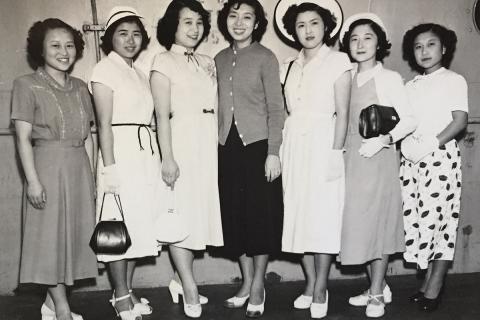
How I Gained 100 Japanese Grandmothers: Reflections on Intergenerational Conversation Inspired by CSWS
by Alisa Freedman, Professor, Department of East Asian Languages and Literatures

by Alisa Freedman, Professor, Department of East Asian Languages and Literatures
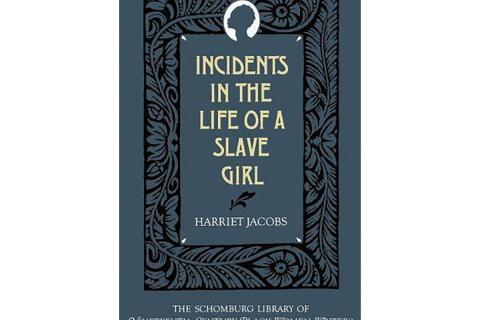
by Faith Barter, Assistant Professor, Department of English

by Diana Garvin, Assistant Professor, Department of Romance Languages
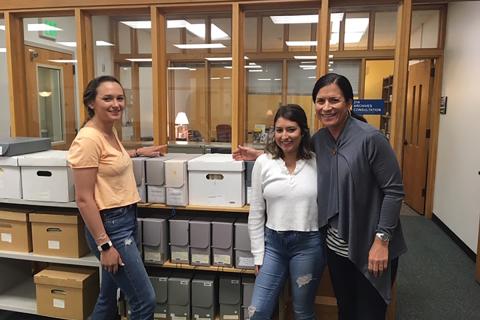
by Kristin Yarris, Associate Professor, Department of Global Studies

by Lina Stepick, Lola Loustaunau, Larissa Petrucci, and Ellen Scott
Despite the continuing threat of COVID-19, and after token efforts such as “hazard pay” to recognize the threat to frontline workers, life in grocery and other retail stores has returned to a new normal of work during a pandemic. Work continues to be dangerous for “essential workers.”
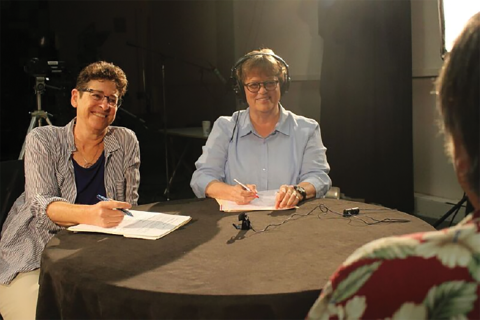
by Judith Raiskin, Associate Professor, Department of Women’s, Gender, and Sexuality Studies
The Eugene Lesbian History Project is a community-based, digital humanities project that preserves and shares the unique history of the lesbian community in Eugene, Oregon. The project includes filmed oral histories with 83 narrators, searchable transcriptions, a digital exhibit that curates and contextualizes the interviews, and a forthcoming documentary film. I am grateful to CSWS for funding the website Outliers and Outlaws that serves as a landing page for all the aspects of this project.
by Claire Herbert, PhD, and Amanda Ricketts, MA, Department of Sociology
Amidst growing economic inequality and rising housing costs in the US, more people are rent-burdened, homeless, or living in over-crowded, substandard, or unstable conditions. This crisis cleaves along pervasive axes of inequality, disproportionately impacting the well-being of women of color and their children, leading to the feminization of homelessness and other housing problems (Bullock et al. 2020; Desmond 2016). Research also highlights the way mothers, and impoverished Black communities, navigate various obstacles to survive and thrive, using informal strategies and networks, or by engaging in what scholars call “activist mothering” (Pittman and Oakley 2018).
by Corinne Bayerl, Senior Career Instructor, Clark Honors College
With the support of a Center for the Study of Women in Society faculty grant, I was able to devote one month in summer 2021 to working on a chapter of a book manuscript on transnational debates over the legitimacy of theatre in Early Modern Europe. While the book as a whole examines the conflicts between supporters and opponents of the theatre across national boundaries and confessional divides, this chapter deals specifically with the role of female theatre practitioners who took on a leading role in the defense of public performances.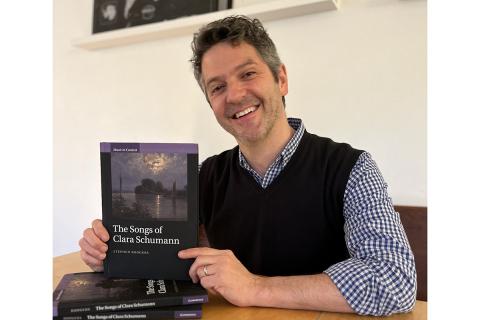
by Stephen Rodgers, Professor and Edmund A. Cykler Chair in Music, School of Music and Dance
In April 2023, Cambridge University Press published my book, The Songs of Clara Schumann, the first book in Cambridge’s Music in Context series to be devoted to the music of a woman composer. Clara Schumann was one of the most talented musicians of the 19th century—a formidable pianist who maintained an active career as a concert performer for 63 years, and a composer who wrote piano music, songs, choral works, chamber music, and instrumental music. But to this day she lies in the shadow of her more famous husband, the composer Robert Schumann. My book places Clara Schumann’s music front and center, focusing on her small but extraordinary output of songs.
By Jina Kim, Associate Professor, East Asian Languages & Literatures
In recent years, Korean TV dramas have become a significant presence on the international television circuit, so much so that some of the most watched shows on over-the-top (OTT) platforms are Korean TV dramas. The Netflix-produced Korean drama Squid Game (2021) and The Glory (2023) are just two of many that have received critical and widespread acclaim, bringing much attention to Korean dramatic storytelling texts. However, what often gets overlooked in these televisual texts are the scenarists who pen these successful stories, many of whom are women writers.