

The Research Program on Women's Health
This program, a former CSWS initiative, dedicated itself to improving the health and well-being of women across the life span. Although this program is no longer housed at CSWS, we keep our affiliation with Dr. S. Marie Harvey (Associate Dean for Research and Graduate Studies, Department of Public Health, College of Health and Human Sciences, Oregon State University).
- Partners Project: The major goal of the project was to evaluate the effectiveness of a theory-based couples' intervention on increasing safer sex behavior.
- Diaphragm Project: The overall goal of this NICHD funded project was to improve understanding of the acceptability of the vaginal diaphragm for the prevention of HIV and other STIs (Harvey, Bird & Branch, 2003).
- CSWS Research Matters, Fall 2005, “Condom Use Saves Lives: So Why is it Being Discouraged?” by S. Marie Harvey. (2 pages)
- Policy Matters 3: Understanding Medical Abortion: Policy, Politics, and Women's Health—Monograph (50 pages - November 2002).
The Feminist Humanities Project
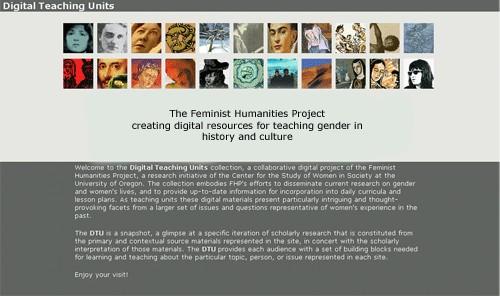
The Feminist Humanities Project (1997-2009), another former CSWS initiative, was a collaborative effort to incorporate and advance the historical study of women in gender in all areas of humanities teaching and research. The Feminist Humanities Project morphed to a much larger project in the digital humanities called the Wired Humanities Project. This entity, now directed by Stephanie Wood, is located in the University of Oregon Knight Library in room 142. The project also has space in the Center for Advanced Technology in Education, in Suite 215 of the Rainier Building. WHP has a growing number of grant-funded projects with colleagues at CATE, which prompted them to share some space there, as well. For a history of the Feminist Humanities Project, as well as an overview of the projects still being expanded upon by the Wired Humanities Project, please see this comprehensive pdf file. You can also go to its active, updated website: Wired Humanities Project.
Caregiver Campaign
In June 2020, CSWS sent an urgent request to UO leadership asking for action to alleviate labor inequities that have arisen from the coronavirus pandemic.
Northwest Women Writers Symposium
The Northwest Women Writers Symposium (NWWS) program began as a CSWS Research Interest Group in 2011. It was so successful that it migrated into CSWS Special Project status as the Women Writers Project in 2012, and became integrated into CSWS as an internal program in spring 2014. The final symposium was held in 2018.
Road Scholars
Road Scholars was a public lecture program of the Center for the Study of Women in Society, a University of Oregon research center devoted to generating, supporting, and disseminating research on the complexity of women’s lives and the intersecting nature of gender identities and inequalities. In addition to introducing the Center and its mission, the Road Scholars program offered audiences the opportunity to engage in conversation with UO scholars about issues critical to women and families in our region and beyond.
Jane Higdon Senior Thesis Scholarship
Although no longer available, the Jane Higdon Senior Thesis Scholarship, with funding of $1,000, was offered for several years. The Center for the Study of Women in Society invited applications from University of Oregon undergraduate students writing a senior thesis or producing a comparable senior project anywhere on campus, within a wide range of disciplines, as long as the thesis or project related to women and/or gender, and demonstrated support of women’s empowerment.
Joy Belsky Memorial Lecture Series
The three-part lecture series honored the legacy of Portland, Oregon plant ecologist Joy Belsky who died of breast cancer on December 14, 2001, at the age of fifty-seven. Funded by a gift from Joy's husband, plant physiologist Robert Amundson, the lectures celebrated Joy Belsky's commitment to equality for women and justice for the earth, her collaborative work ethic, and her courageous refusal to separate scientific research and advocacy. Read more about it in the 2003 Fall-Winter Newsletter.
Feb. 2004: #1 The Public Trust and the Precautionary Principle: Visionary Tools for the Environment and Public Health, speakers were Carolyn Raffensperger (executive director, Science and Environmental Health Network) and Martha Dina Arguello (director, Health and Environment Programs, Physicians for Social Responsibility, L.A.)
Dec. 2004: #2 Hope in the Dark, speaker was author Rebecca Solnit - writer, art critic, and environmental activist. Critics have warmly welcomed Hope in the Dark. Mike Davis calls it "an extraordinary book," applauding how her "prose grows poetic wings that enable her to soar to a visionary height." Studs Terkel appreciates how her book illuminates hope for those "seemingly lost in the woods of deceit and banality, bereft of hope."
Feb. 2006: #3 Gender, Science and the American West: Experiments in the Demilitarized Zone Between Development and Preservation. Speaker was nationally esteemed historian Patricia Limerick.
Ecological Conversations
Ecological Conversations: Gender, Science and the Sacred was partially funded through a grant from the Rockefeller Foundation Humanities Fellowship Program. It concluded with a week of conversations between the 15 fellows and participants and was followed by a public conference.
Read more in the CSWS Newsletter: 1999 Winter, 1999 Spring, 2000 Summer, 2000 Fall, 2001 Winter, 2001 Fall, 2002 Winter, 2002 Spring
Recordings of the Ecological Conversations seminars can be found at the UO Libraries.
LGBTQ Latina/o Youth Storytelling
Special Project for 2015-16
Led by Ernesto Javier Martínez, associate professor in the UO Department of Ethnic Studies, this project connects award-winning writers, aspiring writers, and LGBTQ Latina/o youth with the aim of producing literature that challenges the erasure and distortion of LGBTQ Latina/o lives and that inspires future artistic collaborations seeking to make a positive impact on queer Latina/o communities.
Building upon a record of collaboration by UO faculty members and the new Association for Jotería Arts, Activism and Scholarship, this project will include the following activities: 1) produce literature that centers the experiences of LGBTQ Latina/o youth; 2) create workshops where award-winning writers alongside aspiring writers discuss the craft and politics of producing this kind of literature; 3) teach community members and youth the craft of writing in different genres; 4) distribute volumes of literature at an affordable price for community groups and nonprofits; and 5) develop partnerships with schools, nonprofits, and queer Latina/o youth groups around literature and culture.
The first pilot writing workshop will be dedicated to producing queer Latina/o children’s literature and will be led by the award-winning artist and writer Maya González, whose latest book, Call Me Tree, was recently listed as one of the Kirkus Best Picture Books of 2014 that Celebrate Diversity. The bookcover shown is from her Gender Now Coloring Book: A Learning Adventure for Children and Adults, aimed at ages 3+.