

Comparative Literature
Extreme Domesticity: The Labor of Care in Literary and Visual Culture
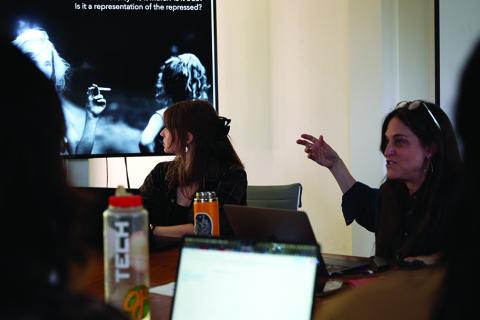
What did students learn in a CSWS Calderwood Seminar last spring focused on our domestic lives? The experimental course, COLT 399 Extreme Domesticity: The Labor of Care in Literary and Visual Culture, was developed by Dawn Marlan, teaching professor and director of undergraduate studies for comparative literature, as one of our CSWS Calderwood Seminars in Public Writing.
Women's History
Encountering Women’s History in a CSWS Calderwood Seminar
by Jenée Wilde, Associate Teaching Professor, Department of English
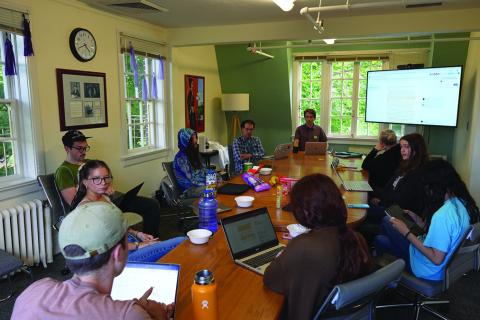
In the Jane Grant Room at CSWS, a dozen students gather around the conference table as their instructor gets the workshop started. This week, classmates in group A are the editors, providing detailed critical and generative feedback to the op-ed writers in group B. Next week, their roles will be reversed. “I really liked that one week we were an editor and the next week we were writing,” said Tanya Gunarathne, a general social science education major and nontraditional student at UO. “Being able to comment on our classmates’ work was intimidating at first, but after a while I was excited to see what everybody wrote, and they were excited to see what I wrote. It was an awesome thing to see.”Calderwood Seminars: Student Work

About: Calderwood Seminars in Public Writing
In Calderwood Seminars, students learn to translate complex arguments and professional jargon in order to make their writing accessible and interesting to a broad audience. These small seminars employ active learning and are designed around short writing assignments that might appear in a blog, magazine, newspaper, or other media outlet. Students revisit knowledge acquired in other courses and shape it for general readers, producing Academic Minutes, book and film reviews, interviews and profiles, op-eds, and other forms of public writing. Course mechanics involve a weekly rhythm of outside-of-class peer editing, in-class workshopping, and delivery of multiple drafts. Students rotate each week between the roles of editor and writer. The skills they teach should be central to a liberal arts education as they are important to life beyond college.

Jayden Taylor: COLT 399, Spring 2026
While many people encounter domesticity through their mothers, the domestic is not an inherently feminine or maternal thing. This is the foundational point of Susan Fraiman’s book Extreme Domesticity: A View from the Margins. Fraiman isn’t solely writing about a negative or restrictive domesticity like the “Angel in the House”— a women who is kept and relegated to the sphere of homemaking— and she’s going further than a set of values, aesthetics, and behaviors that constitute domesticity. Instead, she offers “extreme” as a complication and expansion of domesticity.

Ava Forn: COLT 399, Spring 2026
A movie invites you to stare; to sit on your couch, grab a snack, some blankets and pillows, lie next to someone you care about, and watch people for hours. Sometimes you laugh, cry, feel pain, feel pleasure, but it’s all through the screen; through the simple act of seeing people live their lives. Jeanne Dielman 23, Quai Du Commerce 1080 Bruxelles is a movie that punishes you for this staring. You’re constantly wanting more, to be let into the scene, to know what is happening behind closed doors, between cuts, down dark hallways, and the movie knows this. It’s constantly playing with this desire, this voyeurism, and in the end, it punishes you with it.

Vivian Price: COLT 399, Spring 2026
Dr. Maggie Nelson’s The Argonauts is a tapestry. On the warp, made up of separate threads in parallel, are themes of love, identity, transformation, motherhood, and queerness; on the weft, a continuous thread throughout, is an experiment with language. She’s written a genre-bending book, unbroken by chapters and without citations, considered “autotheory” because of its blend of critical academic theory and autobiography. Her anecdotes are told with saccharine domesticity, or biting sardonicism, or with utter irreverence to enhance the shock value.

Shane Rose: HIST 416, Spring 2025
In about two weeks I will be graduating from the University of Oregon. It took eleven years to get to this point, registering in 2014. I’m certain it isn’t a record for the longest enrollment period as an undergrad, but it is still a rather long time. I’m proud of myself and my accomplishments, sure, but I do have one regret. I wasn’t a Women's, Gender, and Sexuality Studies major. I wanted to be one, as the subject matter deeply impacted who I am as a person and my trajectory in life, but Veteran’s Affairs policy actively prevented me from doing so. I wish to explain both aspects to you.

Shaelyn Thomas: HIST 416, Spring 2025
Two out of every three people diagnosed with Alzheimer’s in the United States are women. While this has been commonly explained by women’s slightly longer lifespans, many researchers have been dissatisfied with that conclusion. It does not explain why Black women are disproportionately affected, or why certain geographic locations show a higher disparity of diagnoses. Nor does it show why there is growing evidence that women are still disproportionately underdiagnosed with Alzheimer’s, suggesting an even higher disparity in cases compared to less than five years difference in lifespan.

Lash Eversole: HIST 416, Spring 2025
We look at the world around us and the remarkable things we can do at speeds people only dreamed about in a not so far past, and when we look at who was awarded and given credit to these great advancements, we see a long list of men with little to no mention of the women who made these achievements possible. It is a brutal and saddening truth how many wondrous minds and their work have been suppressed by men, but it's well past time these women are brought into the limelight and given credit and praise, even after death.
Interviews
Hear student experiences and instructor insights about HIST 416, a Spring 2025 CSWS Calderwood Seminar that focused on 20th century US women's history.
In Spring 2025, Dawn Marlan, teaching professor in comparative literature, taught COLT 399 Extreme Domesticity: The Labor of Care in Literary and Visual Culture. This Calderwood Seminar challenged students to grow as public intellectuals and writers in an intimate workshop setting.