CSWS Annual Review

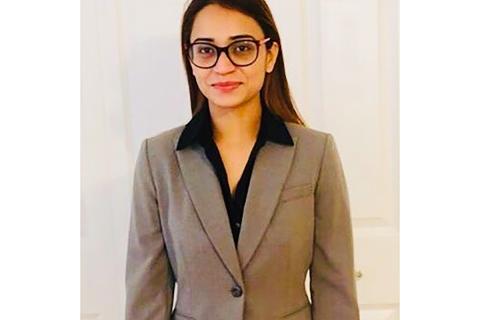
Min Young Park, PhD Candidate, Department of English

Tempting Bad Taste: Unreading the Failure of Art, Fashion, and Food in Late Modernist Novels

by Min Young Park, PhD Candidate, Department of English

Nella Larsen’s Quicksand opens with a vivid portrait of Helga Crane’s room. It is brimming with furniture and garments of her “rare and intensely personal taste” (1). The emphasis on the privacy of her taste is easily overlooked as it is soon followed by a disturbing remark by a white priest who claims that “Naxos Negroes…had good taste” because “[t]hey knew enough to stay in their place” (3)...

The cover of "Drawing the Line: Indian Women Fight Back"

Re-examining Context, Culture, and Medium: Gender in South Asian and South Asian American Graphic Novels

by Anu Sugathan, PhD Student, Department of English

My interest in graphic narratives as a research topic emerged during my master of philosophy studies. While contemplating my thesis, I discovered various Indian graphic novels by contemporary writers and artists that brought back memories of my childhood comic books like Balarama, Balabhumi, and Champak. However, unlike earlier comic books, these graphic novels stood out due to their distinctive style, paper quality, and thematic depth...

Pictured from left are María Galindo, Christina Rivera Garza, and Magela Baudoin

Power of the ‘Multitude’: Women’s Autobiographical Writings in Latin American Literature

by Magela Baudoin, PhD Candidate, Department of Romance Languages

Women’s autobiographical writing has historically faced devaluation within the realm of so-called “high” literature (Huyssen 2006). This marginalization stems from several factors: firstly, the misguided association of “literary” with “fiction,” which tends to discredit narratives perceived as not purely imaginative (Lejeune 1989; Molloy 1996); secondly, entrenched paradigms in modern Western thought...

A still image from the film Good Manners (2017)

‘Feeling With’ Other Bodies: The Posthuman in Latin American Cinema

By Marena Fleites Lear, PhD Candidate, Department of Comparative Literature

Over the last several decades, feminist philosophers have given us different frameworks for understanding how individual and collective bodies are made vulnerable to sociopolitical forces, but also how bodies in turn shape those networks of power. They remind us that our bodies (differentially marked by racism, colonialism, ableism, etc.) are the very stuff of politics.

A chat with a Myanmar Jingo wife, who holds a baby on the left side / photo provided by Xiaobo Su

Aliens at Home: Myanmar Wives and the Exercise of Border Biopolitics in Yunnan, China

by Xiaobo Su, Professor, Department of Geography

In August 2023, at the entrance of Muke village, an ethnic Jingpo (equivalently, Kachin in Myanmar) village one kilometer away from the China–Myanmar border, I and my interpreter parked our car and stopped by a snack shop to learn where to find the village head for more information about cross-border marriage. The female owner, Ruishan, was a Myanmar wife originally from Kachin state, just across the border.
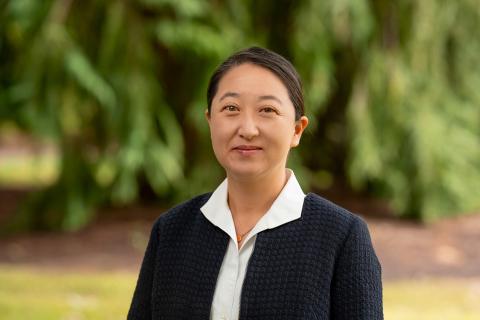
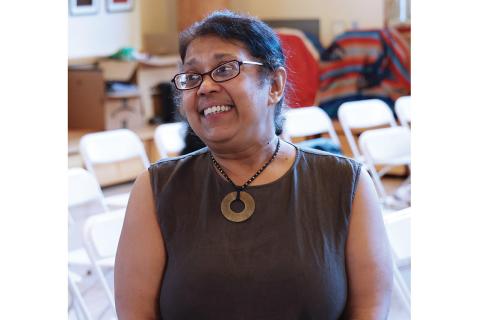
Lana Lopesi

Care: Samoan Feminism, Care Work, and Immaterial Labor

by Lana Lopesi, Assistant Professor, Department of Indigenous, Race, and Ethnic Studies

Two years ago, I moved from Aotearoa, New Zealand, to take up my current role as an assistant professor in the Department of Indigenous, Race, and Ethnic Studies. When we first made the move, the key word was “adjust,” and the mission was to adjust to a new country and to a new academic context, while carving out my own space here. Now that Kalapuya Ilihi is growing in familiarity, I have delved into new research projects, including one tentatively titled “Care: Samoan Feminism, Care Work, and Immaterial Labor.”
The cover of Maya Gonzalez's picture book, "When a Bully is President: Truth and Creativity for Oppressive Times"

Illustrating Resilience: Children’s Picture Books for Oppressive Times

How might children’s literature help us respond to our current political climate? While all literature is politically (or at the very least, ideologically) motivated, a picture book that exemplifies political content for children is Maya Gonzalez’s When a Bully is President: Truth and Creativity for Oppressive Times. Not only is it an indirect comment on Trump but it also reframes US history through bully discourse in its reflections on colonization, slavery, war, and xenophobia. When read as political texts, picture books have the potential to inspire collective action or activism.
Bryant Taylor invites attendees to play a Bingo icebreaker at the 2023 New Faculty Welcome Reception / photo by Jack Liu

Q&A: Bryant Taylor

For two years, Bryant Taylor, a PhD candidate in the Department of Indigenous, Race, and Ethnic Studies, had a special appointment working as a Graduate Employee (GE) on our 50th anniversary events and projects. I had the opportunity to chat with Bryant about his time at CSWS before he left for a summer internship on an African American archival history project at Harvard University.

2023 Annual Review

  • Women’s Visual Protest Movements in Iran: A Conversation with Parichehr Kazemi by Jenée Wilde, Senior Instructor, Department of English
  • Haunting Ecologies by Jenée Wilde, Senior Instructor, Department of English
  • An Invitation from the Director of CSWS by Sangita Gopal, Associate Professor, Department of Cinema Studies
  • Reflections on Gender, Sexuality, and Power
  • New Faculty Reception
Publication Year
2023