CSWS Annual Review

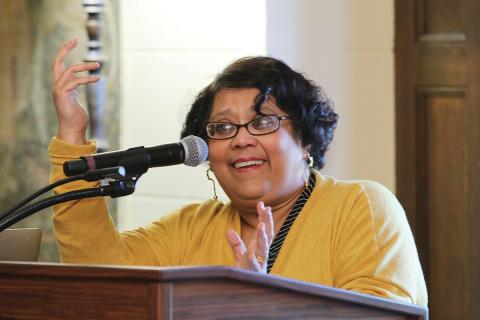
Sangita Gopal, Director of CSWS

An Invitation from the Director of CSWS

by Sangita Gopal, Associate Professor, Department of Cinema Studies

CSWS turns 50 in AY 2023-24! We invite you to a thrilling year of events themed “Feminist Futures” that look to the future while commemorating the past. We will celebrate the cutting-edge interdisciplinary scholarship on gender and intersectionality that the Center has sponsored and disseminated for five decades, and showcase feminist collaborations across the arts, humanities, sciences, and technology that imagine feminist futures to negotiate the challenges of the next fifty. 

Opening reception for the Ghost Forest photography exhibit, which included Bellona's sound installation Wildfire—a 48-foot-long speaker array that plays back a wave of fire sounds at speeds of actual wildfires / photo by Jack Liu.

Haunting Ecologies

During spring term, CSWS presented Haunting Ecologies: The Past, Present, and Future of Feminist and Indigenous Approaches to Forest Fire. This two-week event series included the 2023 Acker-Morgen Memorial Lecture as well as a panel discussion on “Native Ecologies.” Both events were presented in conjunction with Ghost Forest—a photography exhibit by Eugene artist Sarah Grew, featuring Jon Bellona’s sound installation Wildfire.
Washington, DC, Sept. 30, 2022—A protester carries a sign at a protest for Mahsa Amini, freedom in Iran, and solidarity with Iranian protesters.

Women’s Visual Protest Movements in Iran: A Conversation with Parichehr Kazemi

Parichehr Kazemi is a political science PhD candidate at the University of Oregon. She received a 2019 Graduate Student Research Award from CSWS and was the Center’s 2022 Jane Grant Dissertation fellow. Kazemi researches women’s resistance efforts, social media, and social movements across the Middle East, focusing on the ways that women use social media images as a means of protest in Iran. As a CSWS Advisory Board member last year, she drafted the Center’s statement declaring solidarity with demonstrators in Iran who protested the tragic death of Mahsa Amini at the hands of Iranian morality police.
Annie Ring, PhD Candidate, Department of Philosophy

White Women’s Linguistic Terrorism

by Annie Ring, PhD Candidate, Department of Philosophy 

J.L. Austin’s How to Do Things with Words demonstrates that language is not just descriptive but in some cases is performative. That is, Austin’s speech act theory argues that language itself performs, changes, or does things in the world. Speech act theory classically considered institutions like marriage, where a pronouncement weds people into a legally binding relation, or boat christening, where naming and blessing a boat before the maiden voyage protects its passengers (Austin).

W. Jamie Yang, PhD Candidate, Department of Sociology

A Queer Quantitative Inquiry: Sexual Injustices and Social Contexts

My dissertation builds on a stance that views pleasure and safety as fundamental human rights. I am motivated by a wish to democratize pleasure for all, and specifically the questions, “What prohibits individuals from fully enjoying the sexual aspect of their humanity,” and “When it comes to sexual encounters, why do some groups of people consistently have a better and easier time than others?” I use critical feminist theory and queer quantitative methodology to examine how social contexts influence young adults’ experience with sexual injustices and sexual victimization.