

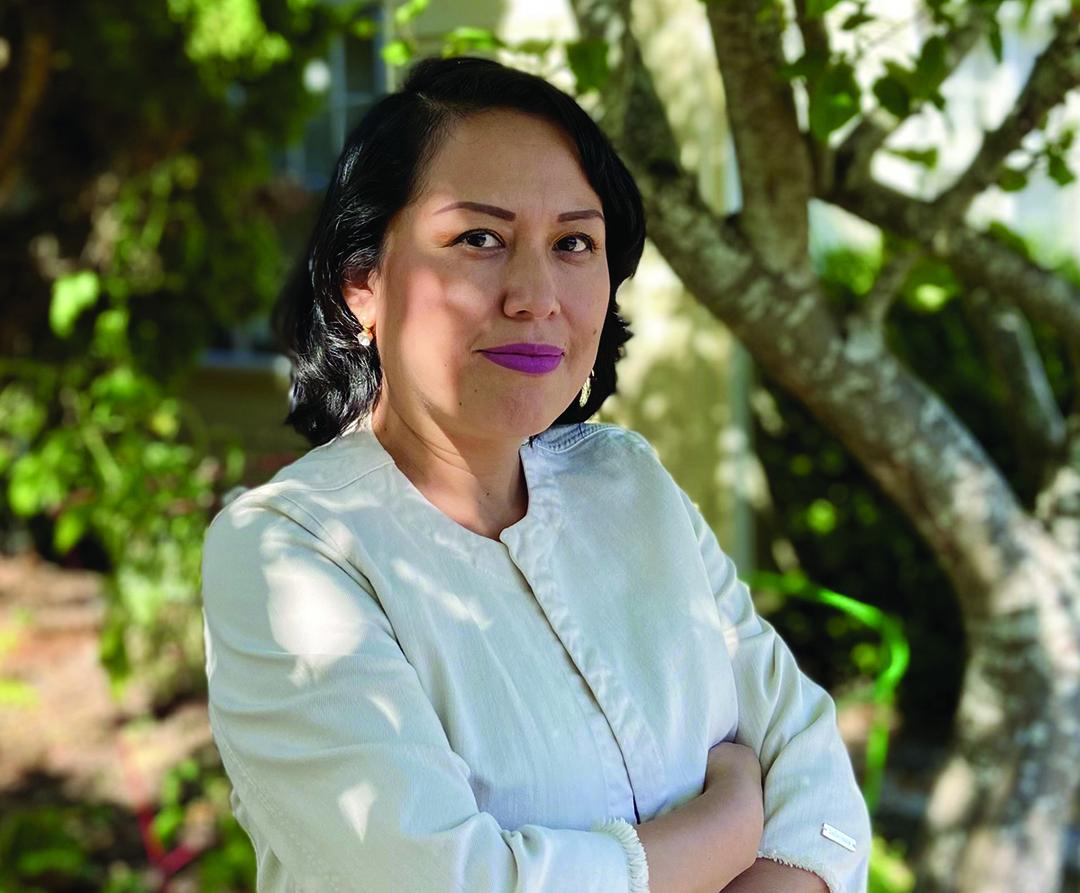
by Gloria Macedo-Janto, PhD candidate, Department of Romance Languages
During the years of internal armed conflict in the Andean country of Peru (1980–2000), as the Truth and Reconciliation Commission (TRC) concluded, Andean women were victimized because of their gender and ethnicity. They played a significant role in the search for the disappeared and in caring for the survivors. However, their contributions have been recognized only from a paternalistic perspective, positioning them as minor heroines of their Andean communities. For this reason, their voices have not been included or taken into account in constructing the overarching narrative of the 20 years of political violence.
In my dissertation, entitled “New Methods of Reading Andean Women’s Roles in Narrating Political Violence in Peru,” I draw on theories of gendered memory, Andean studies, colonialism, and decolonial feminist studies to help ensure that my research contributes to a deeper understanding of the voices of Andean women.
In Chapter 1 of my dissertation, I examine literature, showing how my analysis of Andean women’s testimonies contrasts with the literary texts and cinematic works of the time. The first fictional stories that portray the violence of this era were written by male authors who had greater access to writing, publishing, and distributing their texts (Cox 2000, 2008). I analyze three of these stories: “Camino largo” by Julián Pérez Huarancca, “Al filo del rayo” by Enrique Rosas Paravicino, and “Ñakay Pacha” (The Time of Sorrow) by Dante Castro. The authors are three prominent writers who have received awards and recognition. Therefore, without questioning the literary quality of these stories, I examine the representation of women and, in particular, of Andean women. The selected texts are three of the most widely read stories from that era, in which women appear primarily as figures with unfulfilled dreams, abused, murdered, deluded when they are active, or passive and victimized, almost voiceless and narratively replaceable.
This portrayal of Andean women in early literature on violence, as well as their inclusion in the most important anthologies compiled by scholars in the years following that period, reveals a lack of knowledge about Andean women and the Andean world. They expose the absence of a critical apparatus to perceive Andean women beyond stereotypes and thus relegate Andean women to exotic roles, or to roles of support, accompaniment, or inaction (Guiné et al. 2019).
In these stories, these women are given names that already imply certain characteristics (Flor “flower,” Rosa “rose,” Adelaida “noble appearance”); they assume passive roles, serving as companions or supporters of subversive groups. This is contradictory, even within the stories themselves, because although they were given these names to be part of the narratives, they do not always conform to what is expected of them. In general, the women who appear in these stories are young and from the Andes. Also, while men of all ages appear, the stories do not portray young girls or older women. Their stories are limited to a specific moment in their lives, in relation to others or to the context. These are not stories about them. They are never the protagonists.
The Andean woman in these three literary stories of violence is a young “guerrillera.” She is portrayed as a political subject within the context of violence, but her psychology is not explored further. Her characterization is superficial and does not delve into her inner world or her motivations. These three stories, like others about violence, have contributed to creating a stereotype of the Andean woman who, when she is a leader, is defeated. Likewise, the woman is always defined by the presence of others—she is the daughter of, the sister of, or the partner of someone else who happens to be more significant in the text. The implications for understanding the representation of Andean women shape their characteristics and their agency and have an impact on the narrative not only of the political violence that began in 1980, but on the narrative of violence in general.
—Gloria Macedo-Janto received a 2025 CSWS Graduate Student Research Grant for this project.
References:
Cox, M. 2000. El cuento peruano en los años de violencia. San Marcos.
---. 2008. Bibliografía anotada de la ficción narrativa peruana sobre la guerra interna de los años ochenta y noventa (con un estudio previo). Revista de Crítica Literaria Latinoamericana, 68: 227–268.
Guiné, A., Felices-Luna, M., Dietrich, L., Zapata, A., Romero-Delgado, M., Boutron, C., Meneses, P., Gilbonio, O., and Malek, P. 2019. Género y conflicto armado en el Perú (2nd ed.). Groupe de Recherche Identités et Cultures—GRIC Université Le Havre Normandie.