

Student Opportunities
Undergraduate Initiatives

Research Interest Groups
Research Interest Groups

Women of Color Project
Women of Color

Women in the Northwest
Women in the Northwest

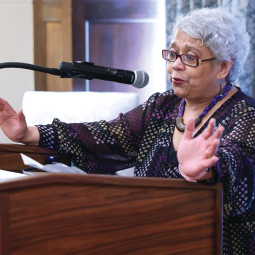
Director's Message: A Year in Review
CSWS Director Sangita Gopal discusses programming highlights from the past year in her column from the 2026 Annual Review.

Programming Spotlight: Undergraduate Fellowships
Fundraising on the University of Oregon's 2026 annual day of giving surpassed our $5,000 goal to support our Undergraduate STEAM Summer Fellowships, which create opportunities for cross-disciplinary collaborations among science, technology, engineering, arts, and mathematics (STEAM) faculty and students on campus. Read about our 2026 STEAM Fellows and what motivated their summer projects.
Highlights from CSWS Programming

The Collaboration Continuum
by Michael Hames-García, Director, CSWS; Professor, UO Department of Ethnic Studies
I am aware of the irony of writing a column by myself on collaborative scholarship. Most likely, any insights contained here would have been strengthened by the participation of others in the writing process. And yet, part of what I would like to say is that in some sense all scholarship is collaborative...

Supporting Women of Color at UO: A Look into the Center's Long-Running Faculty Mentorship Program
by Sangita Gopal, Associate Professor, Department of Cinema Studies
The Women of Color (WOC) Project has been a special project under the auspices of CSWS since 2005. The program is comprised of tenure-track women faculty, and our collective has approximately 50 participants, of whom about 30 are active constituents. We represent all the colleges and schools within the UO.

Collaboration Through Conversation: How CSWS Developed the Research Interest Group Model
by Jenée Wilde, PhD candidate, English
In 1994, the Center for the Study of Women in Society (CSWS) launched a bold new vision—to foster scholarly collaboration through research interest groups, or RIGs. While the center had primarily funded individual research in earlier decades, the RIG model was designed to support a variety of intellectual and social connections among scholars working on gender in broadly related fields.