

by Kaito Campos de Novais, PhD Candidate, Anthropology
This text and collages are a reflection about my vivência in the making of my ethnographic research, which investigates the artistic practices of Latin American diasporas and exiles in Oregon.
A photography exhibition at a theater called Milagro in Portland shows glimpses of hope in urban-scapes: an attempt to inhabit the present tense, according to the artista who I just discovered not only is from my hometown Goiânia but also attended the same university as I did down there. A mural downtown Eugene, made by a Latine artista who months ago taught me to paint gender-bending ribbon eels in a workshop for trans liberation, conceals a message of pleasure inside a colibri kissing a rhododendron. In a Tiki bar on cinco de mayo, a group of Latine drag queens protest the persecution of immigrants by lip-syncing to Mexican hits. Each month a maestra and cultural keeper organizes talleres de arte for Latina mothers and their families inside a museum. This time we are embroidering the memories of our home countries together. Later, the maestra takes me to a book club in the public library where a Cuban poet talks about his creative process and longings. That day I learn there is a route all the way from Mexico to California, through Oregon, and up to the state of Washington, where artistas go circulating their culture and weaving a net of peoples and places to gather around Latin American arte. Those are some of the scenes and lessons I encounter doing fieldwork. But I am not telling you everything. There is more about this world that I cannot afford to describe.
The more I encounter other Latine artistas, more I learn about what is possible to say, write, and create under political precarity. There is a common force affecting both our crafts (arte and etnografia) which is state repression. With these interlocutors I share not only vivências of diaspora, but also the struggle to self-express under conditions of silencing. During interviews and daily interactions, I am constantly listening to stories that never quite finish, hesitations, and... Something unclear, often called “climate,” “news,” “what’s happening,” something hunting us, about to knock our doors, about to stop us on traffic, something I can’t quite name, gets disappeared. This is why most of the data I gather comes in fragments, metaphors, and absences. This is not just self-censoring. Censoring is about a loss while what we do is generative. The absences we give each other are saying a lot. They’re mutual protection, risk assessment, negotiation of trust. When we meet, it’s as if we had secretly agreed that better is to refuse objectivity and be vague so to feed our hope that none of us will get kidnapped after we say goodbye. Most importantly this not-telling makes an alternative mode of narrating our thoughts to each other. It is in the void of coherence and clarity that the imagination is ignited to build other kinds of stories, feelings, images. When the English breaks, we turn to arte.
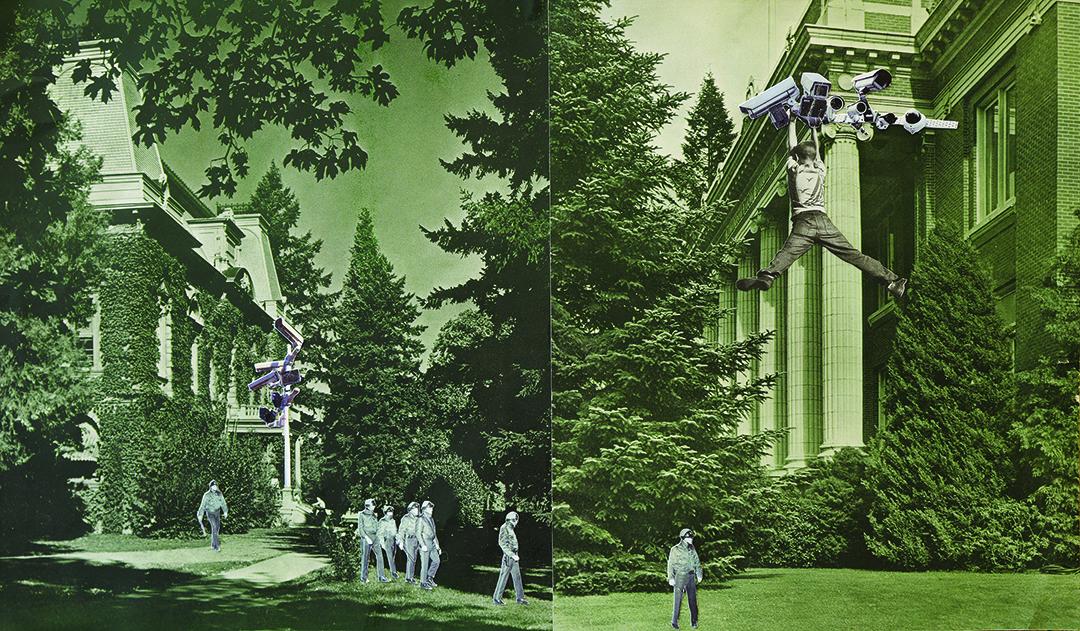
Lately I have unapologetically started exploring writing my etnografia in broken English (which is also the way I sound if you could hear me speaking). This means I’ve decided to be intentionally using oralidade, mixed languages, typos, unclearness, circling, and using multimodal means of telling, such as collages, photos, videos, and illustrations. This is not an original or new thing I am inventing out the blue. I’m inspired by the many feminist anthropologists who opened the ways to speaking academically through affection and multisensoriality, and allowing the subjective, the intimate, and the vulnerable as valid sites for writing (Behar 1996, Pink 2011). I’m inspired by Chicana feminist Glória Anzaldúa (2012) and the hybrid ways we can manifest creatively in borderlands (of language, culture, nation, gender, sexuality, race). I’m inspired too by Brazilian Black feminist Conceição Evaristo (2021) and her concept of escrevivência, a writing through the lived experience, where the racialized gendered body inscribes knowledge from within. I’m inspired finally by queer Latino scholar José Esteban Muñoz’ (1999) idea of disidentification: to perform through the hegemonic in-between refusal and assimilation. This way, my broken English plays between my craving for being understood and inability of saying ideas deemed too risky for the mouth to spell it out in the normative way.
See these images as one manifestation of this broken English. They are the first thing I wrote from fieldwork. Rather than illustrating or decorating the text, these images are a form of narrative evoking imaginary landscapes that come directly from the heart. Conjured visions of what it feels like doing anthropology in this world.
—Kaito Campos de Novais received a 2025 CSWS Graduate Student Research Grant for this project.
References:
Anzaldúa, Gloria. 2012. Borderlands/La Frontera: The New Mestiza. 4th ed. San Francisco: Aunt Lute Books.
Behar, Ruth. 1996. The Vulnerable Observer: Anthropology that Breaks Your Heart. Boston: Beacon Press.
Evaristo, Conceição. 2021. Escrevivência: A Escrita de Nós. São Paulo: Fundação Itaú Social.
Muñoz, José Esteban. 1999. Disidentifications: Queers of Color and the Performance of Politics. Minneapolis: University of Minnesota Press.
Pink, Sarah. 2011. “Multimodality, Multisensoriality, and Ethnographic Knowing: Social Semiotics and the Phenomenology of Perception.” Qualitative Research 11 (3): 261–76.