

by Olivia G. Wing, PhD Candidate, Department of History
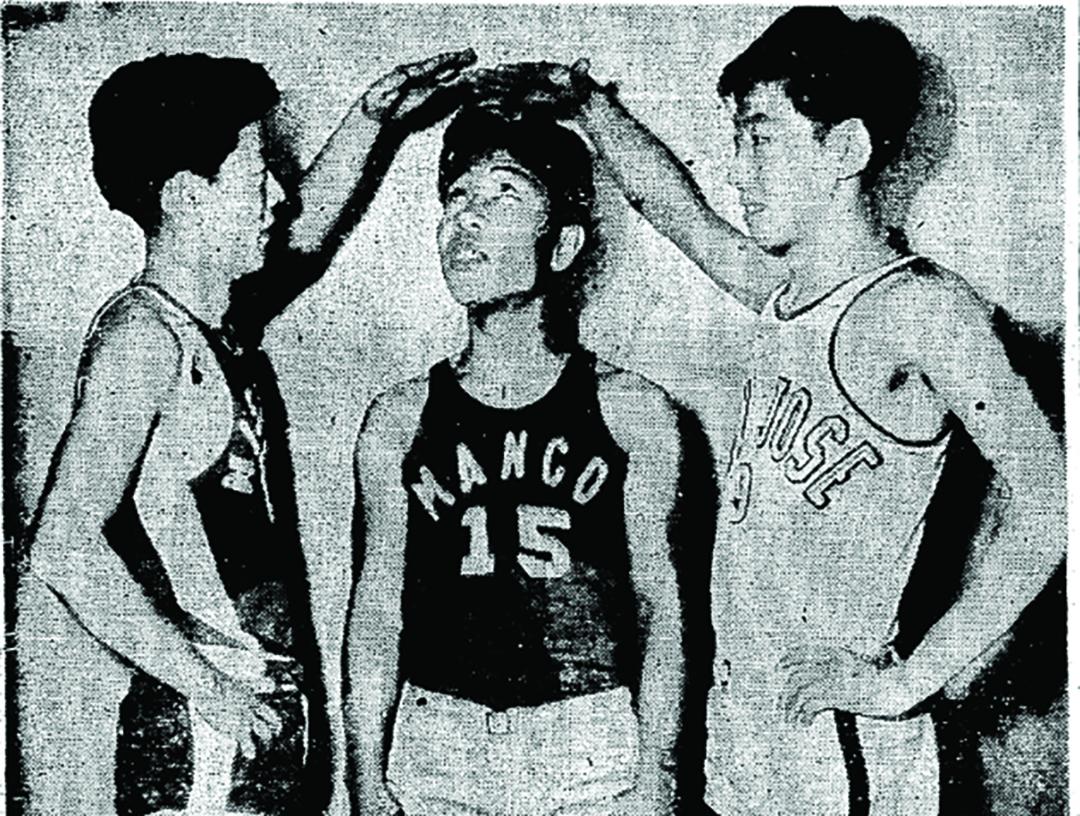
In 1947, eight Asian American men’s basketball teams traveled from California, Oregon, Utah, Illinois, Hawaii, and British Columbia to Seattle, Washington to play ball in the first Oriental–American National Basketball Tournament (OANBT). The four-day tournament concluded with a social dance honoring the victorious team and runners-up, as well as an Outstanding Player award to an individual player. The goal of the tournament was purportedly simple: to identify the most gifted Asian men’s basketball team in the United States. The tournament, however, was the first of its kind. Prior to WWII, the Asian American sporting landscape was largely segmented by national origin and region. By defining the boundaries of the OANBT in terms of pan–Asian identity and geographic scope, these games signaled the creation of the figure of the Asian American male athlete—a figure representing new norms of masculinity and patriotic national belonging for Asian immigrant communities seeking to enact social mobility in the postwar period.
Organizers of the OANBT closely aligned the tournament with postwar American nationalism. Promotional material for the tournament’s first year narrated the games as a metaphor for war, equating athletes to soldiers, calling the court a “battlefront,” and alluding to game rules as codes of honor (“Oriental–American Basketball” 1947). Seattle’s Chinese and Japanese American veteran’s committees, the Cathay Post 186 and the Nisei Veterans Committee, organized and co-sponsored the tournament’s first few years and proceeds from the games went to deceased veterans’ families. The basketball players that competed in these games, therefore, represented an extension of the patriotic service rendered by fellow Asian Americans during the war. During WWII, military service among second- and third-generation Chinese and Japanese American men was instrumental in legitimizing Asian immigrant communities’ claims to American belonging and loyalty (Wong 2005, Hsu and Wu 2015). Veteran organizations’ involvement in organizing a national sporting event illustrates that they saw sports as a useful avenue for representing values of masculinity for their community that were perceived as widely honorable—similar to their own miliary service.
So why basketball? For one, basketball’s popularity as a sport was on the rise in the United States following WWII. In addition, the sport itself was relatively young and had room for up-and-coming players and leagues to make their mark on the game. For context, the National Basketball Association did not consolidate until 1949—a full two years after the first Seattle tournament took place. As a game, it differed significantly from the version we see on screens today. The modern-day version of basketball has become inextricably intertwined with blackness, an association that builds on racial stereotypes about Black men’s height, size, and athletic ability—all physical traits that became synonymous with the new style of gameplay that emerged in the late 1950s and 1960s when leagues integrated (Goudsouzian 2010).
Asian American men contended with a different set of stereotypes dating back to the nineteenth century that rendered them either transgressively feminine or threateningly brutal (although still small in stature, e.g., Fu Manchu, The Cheat) (Sueyoshi 2018). But in 1947, players themselves did not shy away from advertising smallness as a key component of their identities as athletes. The OANBT’s own slogan, for example, read “Season’s Biggest Little Tournament” and their promotional materials and program describe players as “efficient” and “smooth” and compliment the “speed and drive” that players’ size enabled on the court. They leaned into making their size a component of how they represented their sporting culture and skill to each other to exercise control over the existing racial language around their value as athletic competitors and claims to masculinity. Most importantly, the inclusion of Chinese, Japanese, and Filipino American players in the tournament signals a concerted interethnic effort to exert control over derogatory racial narratives shared among Asian immigrant men.
By basing representations of their masculinity in a popular American sport and subverting racialized language to describe their own style of gameplay, Asian men could excel in this tournament without forcefully challenging the status quo. And by consolidating previously siloed teams into a larger pan–Asian competition, organizers gave Asian American basketball players a larger stage upon which to prove their athletic skill. Most importantly, the OANBT provided a literal arena for men to articulate a new version of masculinity for the postwar period. This tournament faded a mere decade after it began, but it provides a window into the forgotten history of Asian American basketball.
—Olivia Wing is a PhD candidate in history and a recipient of a 2025 CSWS Graduate Writing Completion Fellowship.
References:
Goudsouzian, Aram. 2010. King of the Court: Bill Russell and the Basketball Revolution, University of California Press.
Hsu, Madeline Y. and Ellen D. Wu. 2015. “‘Smoke and Mirrors’: Conditional Inclusion, Model Minorities, and the Pre-1965 Dismantling of Asian Exclusion,” Journal of American Ethnic History 34 (4): 43–65.
“Oriental–American Basketball Tournament Souvenir Program.” 1947. Wing Luke Museum Archives, December.
Sueyoshi, Amy. 2018. Discriminating Sex: White Leisure and the Making of the American “Oriental,” University of Illinois Press.
Wong, K. Scott. 2005. Americans First: Chinese Americans and the Second World War, Harvard University Press.