Palenqueras and the Trap of Visibility
By Maria Fernanda Escallón, Assistant Professor Department of Anthropology

By Maria Fernanda Escallón, Assistant Professor Department of Anthropology

by Mayra Bottaro, Assistant Professor, Department of Romance Languages
by Alaí Reyes-Santos, Associate Professor, Department of Indigenous, Race, and Ethnic Studies, and
Ana-Maurine Lara, Assistant Professor, Department of Women’s, Gender, and Sexuality Studies

by Nicole Giuliani, Assistant Professor, School Psychology Program

Interviewed by Michelle McKinley, CSWS Director and Professor, School of Law, and Alice Evans, CSWS Managing Editor
With a new book forthcoming from Cambridge University Press, Angela Joya is pressing forward with more projects focused on the Middle East and North Africa. An assistant professor in the UO Department of International Studies, Joya was born in Afghanistan, lived for twelve years as a refugee in Pakistan, and immigrated with her family to Canada when she was sixteen.
Q :Tell us about your book project.
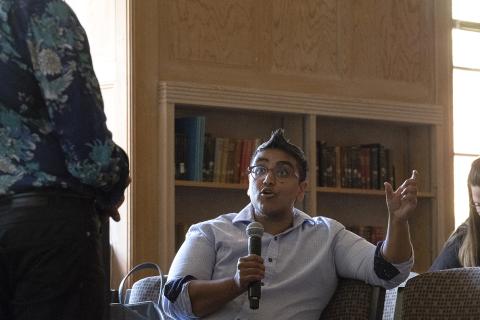
V Varun Chaudhry worked as a CSWS pro tem research assistant during AY 2018-19 while completing his dissertation through the Department of Anthropology at Northwestern University. He is now an instructor in the Women's, Gender, and Sexuality Studies Program at Brandeis University. V’s research focuses on the institutionalization of “transgender” in nonprofit and funding agencies through ethnographic research in Philadelphia, PA.
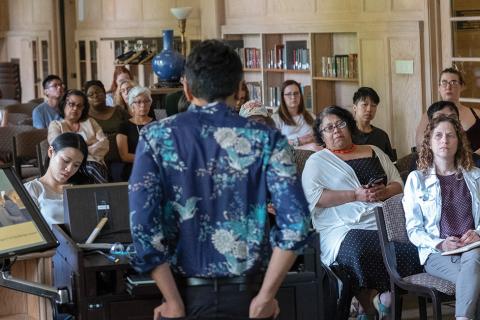
In late May, CSWS concluded its three-year focus on “Women and Work” by joining with the recently renamed Department of Indigenous, Race, & Ethnic Studies in a celebration of the publication of a book that had its origins in Hendricks hallowed hallways. Shireen Roshanravan was doing post-doctorate work in the Women and Gender Studies Program at UO during 2009-10 with the mentorship of Lynn Fujiwara—now an associate professor in the Department of Indigenous, Race, & Ethnic Studies at UO—when they began a collaborative relationship in their shared focus on Women of Color feminisms.
I started as director of CSWS in the summer of 2016. Sadly for us, CSWS lost two of our founding mothers within months of each other in 2016. Joan Acker and Sandi Morgen, pathbreaking feminist titans, made the Center a focus of research and activism around women’s economic rights and security for over forty years.