

Fundraising on the University of Oregon annual day of giving surpassed our $5,000 goal to support undergraduate research on gender.
For Ducks Give 2026, donations to CSWS on May 14 raised $5,360 from 39 gifts and unlocked two challenge gifts: $500 from Beate Galda, and $2,500 from Thomas Beaumont. We thank all our donors for generously supporting the next generation of cutting-edge feminist research at the University of Oregon.
All gifts made to CSWS go to our Undergraduate STEAM Summer Fellowships, which create opportunities for cross-disciplinary collaborations among science, technology, engineering, arts, and mathematics (STEAM) faculty and students on campus and enhance pathways for underrepresented students in STEAM to succeed.
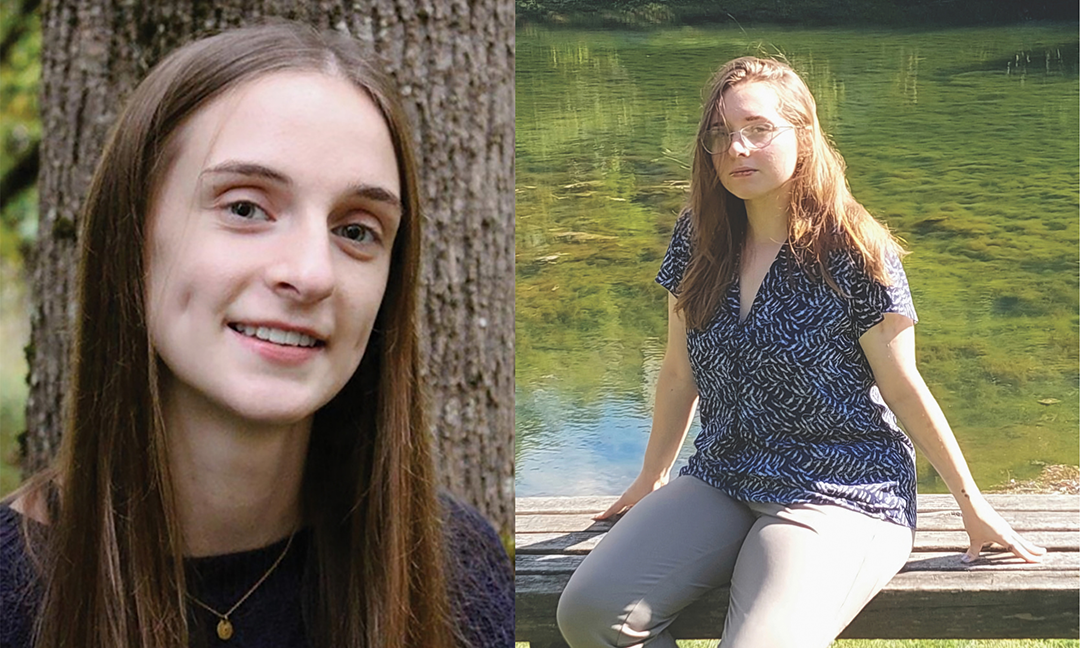
Through a competitive application process, CSWS selected biochemistry major Claire Jones and dance major Michelle Rogers as our 2026 STEAM Fellows.
A senior majoring in biochemistry and minoring in bioengineering, Jones conducted summer research for the project “Understanding Female–Specific Factors in Osteoarthritis” under the supervision of Associate Professor Nick Willett in the Willett Lab at the Phil and Penny Knight Campus for Accelerating Scientific Impact. Application materials state that the project aims to increase our understanding of how female-specific factors contribute to degenerative joint diseases such as osteoarthritis, which is characterized by chronic low-grade inflammation that can cause degradation of joint cartilage. Jones spent time over the summer culturing cells, planning experiments, and analyzing samples in the Willett Lab.
“Traditional animal models are limited in their translational value when studying sex-based factors,” Jones’ application noted. “Therefore, the objective of this project is to engineer a human-specific cartilage hormone microphysiological system (CHo-MPS) to study sex-specific hormonal factors such as the role of estrogen.”
A junior majoring in dance and minoring in chemistry, Rogers conducted summer research for the project, “Partitions for Performance: A Summative Model for Analyzing Gendered Connotations in Dance” under the supervision of Assistant Professor Amy Swanson in the School of Music and Dance. According to application materials, the project “aims to develop a more objective approach to choreographic analysis that renders commonalities among ‘feminine’ and ‘masculine’ movement patterns discrete enough to represent mathematically.” Rogers worked over the summer to quantify the component movements of a variety of dance forms that have a history of gendered connotation, used the resulting model to generate three distinct solo works meant to elicit gendered perceptions (feminine, masculine, or neutral), then analyzed the results when presented to an audience.
“Whether or not gendered movement patterns can be quantized using this specific format,” Rogers’ application noted, “the project will ultimately expand on movement as a mode of compliant and subversive gender expression for cis and genderqueer people alike.”
The STEAM Fellowship provides grant funding for undergraduates ($3,000) and faculty mentors ($1,000) to partner on research-based summer projects that support the Center’s mission to create, fund, and share research that addresses the complicated nature of gender identities and inequalities. Final products for the fellowship may be in any genre, such as an article, website, comic, podcast, performance, or short film. Interviews with past STEAM Fellows discussing their research projects can be found on our YouTube channel.
As part of the application process, Jones and Rogers wrote personal statements that share how their experiences and goals reflect the CSWS mission. Their stories, shared below with permission, illustrate the importance of continuing these fellowships.
—Jenée Wilde, associate teaching professor of English, CSWS research dissemination specialist
Claire Jones Personal Statement
When I was in third grade, my parents signed me up for a summer basketball camp hosted by the Milwaukie High School girls’ basketball team. On the first day I realized only two other girls had signed up for the camp. The organizers decided to combine us with the boys’ camp for the rest of the week. The next day I arrived to a gym full of campers, the boys’ high school basketball team, and coaches, and just us three girls. I felt intimidated and out of place in this new environment, but I continued to show up and played through the discomfort. By the end of camp, I’d improved my skills, had fun, gained confidence, and was proud I stuck with it.
Girls are twice as likely to drop out of sports than boys. This past summer I worked as a camp counselor. In the sports camps, girls remained underrepresented. Remembering how it felt to be one of the few girls, I made it my mission to be encouraging and approachable, and to serve as a visual representation for female athletes in male-dominated sports. I worked to build connections and empower girls to take up space and play confidently. I hope I inspired them to continue in sports and left them feeling they belonged.
I am grateful for the life skills I have gained through athletics and hope to see more girls benefit from similar experiences. I now carry these lessons into another male-dominated space of STEM. At times I have struggled and felt inadequate, but I use the perseverance and resilience I developed from my early experiences to push forward. These experiences have shaped my commitment to increasing representation for women in science. Greater diversity within the field is essential for driving research for historically underrepresented groups. I am proud to contribute to this effort and be joining a lab that is committed to advancing research on female-specific factors.
Michelle Rogers Personal Statement
Since childhood, I have consistently felt out of place. While it has most likely shifted over time through changes in age and location, there has always been something distinctly off with my perception of myself and the version of myself that I picture operating comfortably in the world around me. Something that only I can conceptualize and therefore something I have yet to accurately put into words.
My main respite has been the recent surge in stories and information I have been given as a university student that demonstrate the ways social categories are created in our society, the ways insecurity and uncertainty develop within a person, and the abstract nature of nearly every branch of science I once thought was absolute. I started my journey at the UO as a chemistry major seeking to understand the aspects of the world I cannot visually perceive. I wanted to be able to predict and appreciate the behaviors and reactions that run the globe with as much accuracy as possible. Overall, the idea of being able to explain elements of life that are initially mystifying sounded like a promise of importance and introspection; my own placement in the world made so little sense to me that I found agency and reassurance in being able to explain everything else besides myself. Despite the fact that chemistry is now my minor and dance is my major, I still feel a sense of childlike wonder when a new phenomenon or pattern surprises me with its existence in my elective classes. Its intricate beauty grounds me and gives me hope for the application of complex relationships to areas so widespread and ancient as the performing arts. There is little need, I feel, for artists to fear the sciences and vice versa, and I hope to show more and more people that they are capable of expanding their practices to new idioms through future works similar to this project.
By the end of my sophomore year at the UO, I had officially made dance my major after recognizing that I would live a life of regret if I did not pursue it as a future career. For chemistry, I have a deep fondness, but dance will forever live alongside water and air as a force I need to survive. This is meant both in a metaphorical and literal sense, as I had just completed 10 weeks of intensive group therapy while I was supposed to be enrolled in winter term. Being forced to confront the sources and patterns of my struggle demonstrated to me that compromising on my future for monetary or societal reasons alone was pointless. I needed to make my future personally precious if I wanted to make it past the age of 20, and fully investing in the art form that held me through all my dangerous moments was the most obvious way to make that happen.
Movement has also been a major mode of gender affirmation areas of my life since I recognized at 18 that I identify with being genderqueer more than I identify with being a woman. Considering I am almost always perceived as a woman due to my voice and appearance, it has become one of the only ways in which I can create worlds where my femininity is not the foremost subject matter of my existence. Where I can explore the shapes and images I display to the audience on my own terms. This project aims to honor dance’s affirming abilities and gendered histories by delving deeper into movement as gender performativity and displaying agency through composition, and I hope that it can eventually help other queer dancers like me to feel a bit more held by the performing arts world.