

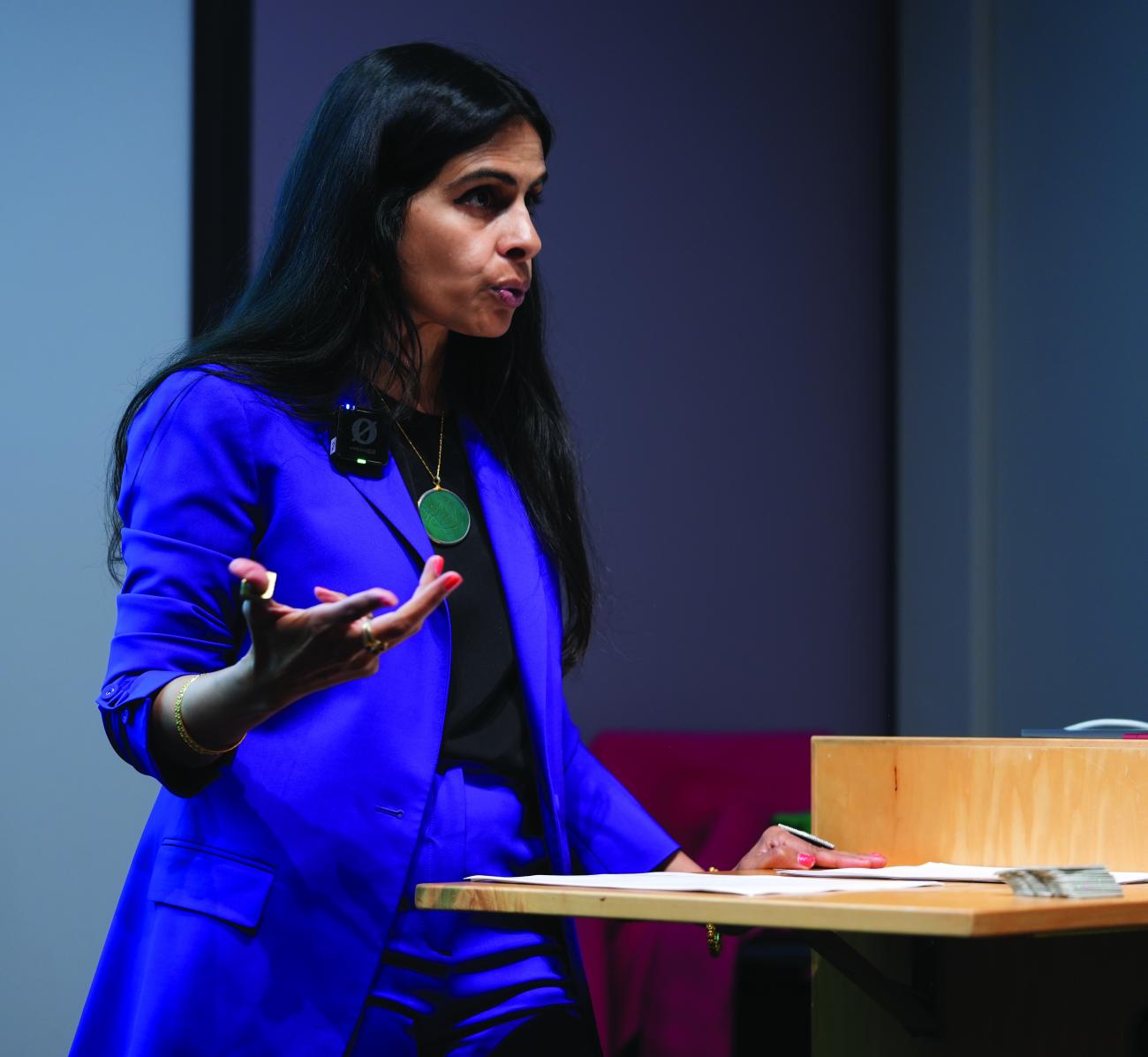
The Ford Lecture Hall is buzzing as students and faculty chat animatedly, plates of food and drinks in hand. At the front of the high-ceilinged room in the Jordan Schnitzer Museum of Art, guest of honor Dr. Durba Mitra chats amiably with CSWS Director Sangita Gopal. There’s a delay while museum staff work to fix the podium’s microphone, but no one is in a rush. Here in this windowless lecture hall, friends and colleagues catch up, laugh at jokes, and talk excitedly about their latest research. There’s a communal feeling in this space that reflects the focus of tonight’s talk: What if gathering together liberated us?
At the front, a staff person has a work-around for the failed sound system, and Dr. Mitra is ready. The full room hushes as Sangita begins her welcome, introducing our guest speaker and the legacies of Joan Acker and Sandra Morgen, for whom the lecture series is named.
Dr. Mitra is the Richard B. Wolf Associate Professor in Studies of Women, Gender, and Sexuality at Harvard University. Her scholarship brings together feminist political thought, sexuality studies, and global intellectual history. Her new book, The Future That Was: A History of Third World Feminism Against Authoritarianism (Princeton University Press, 2026) describes how Third World women in the 1970s seized the means of knowledge production to fight against rising authoritarianism and imagine a future freer than our present.
The CSWS Acker–Morgen Memorial Lectureship honors two powerful feminist voices, CSWS founding director Joan Acker and longtime Center director Sandra Morgen, both of whom passed away in 2016. This annual lecture series commemorates their legacies by bringing to the University of Oregon renowned feminist scholars who work on issues of economic justice and gender equity—issues that were very near and dear to both Joan and Sandi.
The audience applauds as Dr. Mitra steps up to the podium, the cover of her new book projected on the large screen behind her along with the title of tonight’s talk. In the audience, three CSWS graduate student research fellows jot careful notes so they can share their reflections with you.
Reflection by Anu Sugathan, Department of English
On May 13, Prof. Durba Mitra delivered the 2026 Acker–Morgen Lecture as part of CSWS’s annual lecture series. Her talk primarily drew from Chapters 2 and 3 of her new book, The Future That Was. She discussed how Third World women (a term used as a language of solidarity and liberation among women in decolonizing and postcolonial contexts) built feminist knowledge across borders in the 1970s and 1980s through research, reports, conferences, organizations, books, archives, and protests. She also noted that the founding of CSWS coincided with this period of feminist scholarship, reflecting women’s efforts to imagine more just futures amid rising authoritarianism.
What I found especially interesting was her attention to the different media forms through which women connected transnationally. Mitra also discussed how early “status of women” reports in the 1960s and 1970s often used varied methods such as illustrations, qualitative research, and close textual analysis. By the late 1980s, however, these reports became more standardized around surveys, demography, statistics, and policy language. Her discussion of the 1977 India report and Shirkat Gah’s 1997 Pakistan report showed how cover images could powerfully frame feminist critique. At the same time, Mitra argued that standardized development reports, often shaped by UN, state, NGO, and foundation-funded research, made women visible as policy subjects while narrowing feminist thought into bureaucratic and social-scientific forms. This standardization left less room for political complexity, including issues of caste, class, sexuality, state violence, and minority oppression.
This connects to her reflection on the new book’s cover, taken from Shahzia Sikander’s Infinite Woman exhibition at Pilar Corrias, which she described as the image of the “sun as a horizon of possibilities.” It is in fact a visual reminder that feminist knowledge is not only about documenting oppression, but also about imagining futures, solidarities, and different forms of freedom.
—Anu Sugathan is a PhD candidate in English and recipient of a 2023 CSWS Graduate Student Research Award. She is also a coordinator for the Decolonial, Feminist Futures of Comics Studies RIG.
Reflection by Maia Wellborn, Department of Philosophy
In my view, the most interesting aspect of Durba Mitra’s critical genealogy was her emphasis on the ambivalence of collusion with state power, which operated as a strategic point of proliferation of third world feminist literature. Focusing on the genre of the “status report,” Mitra showed that while research was carried out by localized women’s groups, these reports functioned to “standardize,” by the 1980s, approaches to women’s status that contributed to an expanding domain of state-sanctioned (biopolitical?) authoritarianism and secularization.
Especially in the case of India’s Toward Equality, which was published hastily in December 1974, the report envisages women’s equality within discursive techniques of technocratic statehood. It embraced liberalist notions of equality while forfeiting accounts of lived experience, artistic elements, and intersectional approaches for quantitative social science, surveys, and comparative description. Only six months later would Indira Ghandi, India’s first woman prime minister, declare the authoritarian measure that was a widespread afront to human rights. Writing about the democratization of women’s possibilities required, ironically and counter-conductively, the “master’s tools.”
Mitra’s guiding questions exceeded historiography. What were the aspirations—the hopes and dreams that motivated the work of feminist exemplars and organizations coalescing in the global south? Such interrogation also invites us as feminist scholars and practitioners to reimagine, in the present, what the absences and presences of the archives can do. Mitra shared photos from a Bengali conference of 1986 that depicts a group of women holding each other, animated and embracing. Despite borders and differences, these women had gathered and smiled. The photos contrast strikingly with the arid formalism of the social scientific report.
Mitra’s lecture led to a vibrant Q&A about the role of third world feminist epistemologies, affective constellations, and communal practices. It also gave occasion for reflecting on the dreams of these women for a freer world—dreams whose collective promise and temporalities continue reverberating.
—Maia Wellborn is a PhD candidate in philosophy and recipient of a 2026 CSWS Graduate Writing Completion Fellowship.
Reflection by Nishat Parvez, School of Journalism and Communication
“Third world feminism was, at its heart, a project of anti-authoritarianism.” That line from Dhurba Mitra stayed with me long after the lecture ended. Listening to Dr. Mitra speak felt less like attending a formal academic talk and more like being guided through a history of feminist struggle, collaboration, and resistance across borders.
What stood out to me most was the way Dr. Mitra connected research with political survival. She spoke about women across South Asia, Africa, the Middle East, and other postcolonial societies who used reports, archives, workshops, and feminist organizations not simply to study women’s lives, but to challenge authoritarian governments, militarism, and inequality. Before this lecture, I often thought about policy reports as distant academic or bureaucratic documents. Dr. Mitra helped me see them differently. Behind those reports were women traveling across countries, gathering stories, documenting injustice, and trying to make marginalized lives visible in political systems that often ignored them.
I was especially moved by her discussion of collaborations among women from India, Pakistan, and Bangladesh despite histories of violence, war, and political division in the region. The photographs and stories she shared made these histories feel deeply human rather than distant historical events. The lecture reminded me that research is never only about data or archives; it is also about relationships, memory, and collective care.
As someone researching media, gender, and informal political spaces in Bangladesh, I found myself reflecting on my own work throughout the lecture. Dr. Mitra’s talk pushed me to think more carefully about whose voices become preserved, whose knowledge becomes legitimate, and how fragile spaces for critical scholarship can become during moments of authoritarianism. I left the lecture thinking not only about the past she uncovered, but also about the futures researchers are responsible for protecting and imagining together.
—Nishat Parvez is a PhD candidate in Communication and Media Studies and recipient of a 2025 CSWS Graduate Student Research Grant.