

by Jenée Wilde, Associate Teaching Professor, Department of English
What did students learn in a CSWS Calderwood Seminar last spring focused on our domestic lives?
“We’re talking a lot about the concept of the home, how that is represented by various forms of art,” said Jayden Taylor, a junior majoring in music history and culture and comparative literature. “We’ve read memoirs, looked at photography, watched movies, and are really trying to dissect, what does it mean for something to be domestic? Is it explicitly connected to women? Is it more expansive than that? Who gets access to it? Things like that.”
“We’re talking about a lot of things that relate to the idea of being home and carving out that space for self-identification and living,” said Vivian Price, a senior majoring in classics and comparative literature. “I think discussing this topic is important because we’ve historically ignored women and the home space. It’s the center of a lot of change and growth.”
“It has made me appreciate a lot of the domestic parts of my life, and also the people who have shaped my ideas of the domestic,” said Nina Gomez, a senior general humanities major. “When I go into domestic spaces like my friends’ homes, I’m looking at it now with a lot more intention and paying attention to the details of how their internal worlds are projected onto the external.”
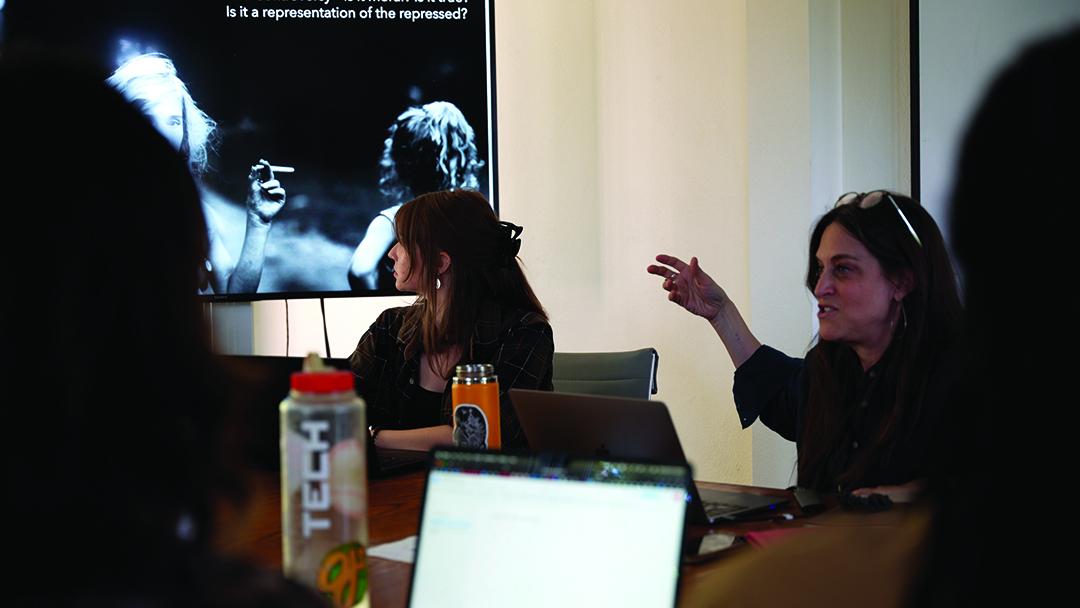
The experimental course, COLT 399 Extreme Domesticity: The Labor of Care in Literary and Visual Culture, was developed by Dawn Marlan, teaching professor and director of undergraduate studies for comparative literature, as one of our CSWS Calderwood Seminars in Public Writing. According to the syllabus, to “domesticate” is to tame that which is worldly, other, and wild. “But home-work—the labor of care—blurs the public/private distinction that undergirds the gendered, classed, and racialized separation of spheres. Rejecting ‘domesticity’ as if it were synonymous with complacency devalues this labor and forgets the uncanny, destabilizing potential inherent in the intimate and aesthetic encounters so central to domestic life. Moreover, the aesthetics and politics of domesticity “take on a new urgency with shifting political power structures in the US and the emergence of the glamorized trad wife on social media.” By looking at and writing about essays, memoirs, films, and works of art centered in the domestic sphere, students in the course “grapple with competing narratives about the value of invisible labor performed by disempowered populations, endeavoring to make nuanced ideas about domesticity accessible to a broad audience and to take responsibility for interpreting cultural materials and shaping public discourses.”
“It’s a class that was inspired by Virginia Woolf’s A Room of One’s Own,” Marlan said. “There’s a moment where she talks about the kinds of things that get recorded as history are always monumental, masculinist contributions, like wars and industry, whereas the kinds of experiences that have been traditionally assigned to women and that have been traditionally experienced by women are invisible.”
For a long time, Marlan has been interested the domestic realm and its connections to all kinds of other experiences that involve material culture and relationships of intimacy that are “the vital stuff of life and the stuff that has gotten left out, the stuff that’s been marginalized, the stuff that’s been devalued or at least undervalued,” she said. “I think it’s important to meditate on and think about this experience that has been so important to half of the population…It broadens the conversation about what matters.”
Calderwood Seminars challenge students to grow as public intellectuals and writers in an intimate workshop setting. With the aesthetics and politics of domesticity as their topic of inquiry, students worked through spring term to build writing portfolios that included film and book reviews, museum exhibition wall texts, and personal essays. Classes involved discussions, collaborative editing workshops, guest lectures, and a museum visit, as well as independent research.
“I feel like I have a lot more awareness of what it is I’m writing, what purpose it’s serving, and who might be seeing it, which then is helpful and informative for my revision process,” said Chago Gause, a senior majoring in comparative literature. “We have a shared goal of just trying to create the best writing, and that in turn really takes a lot of pressure off and makes everything more enjoyable.”
“I really like the collective feel of the class—it very much feels like we’re all a group of equals, all trying to help each other advance,” said Ava Fawn, a freshman majoring in comparative literature and sociology. “I feel like in a lot of my previous essays, my audience was my instructor or a very academic setting, but I’ve now written film reviews, wall texts, and chapter reviews for a very basic audience, something to be published on a website. How much your writing changes when you change your audience is incredibly interesting. It’s very freeing. I’m allowing myself to play with new things that I had sequestered off because they weren’t academic enough, and I also think it’s honing my own style. How do I want to convey my ideas? How artistic or academic do I want to sound? Finding the synthesis between those two things in my own writing is one of the biggest developments I’ve noticed from the seminar.”
“The Calderwood Seminar puts the focus on the writing,” Marlan said, “and that’s something that has become increasingly difficult to teach—partly because of the advent of AI, and partly because of just how education has changed and what the emphases are on now. This is a rare opportunity to focus on student writing.”
The CSWS Calderwood Seminars are funded through donations raised during our 50th anniversary and through a grant from the Calderwood Foundation. These CSWS teaching fellowships support six seminars across campus on gender-related topics over three years, including a course stipend that can be used to pay for guest speakers, field trips, class materials, and more.
“It’s so wonderful that we got this outside funding to be able to do this,” Marlan said. “I think most students feel like real learning happens when they have so much of a voice in the classroom, when they have so much individualized attention. It becomes this kind of conversation that feels organic and meaningful, where people are coming together and are very curious about what each other thinks. And for me, that’s really what’s at the heart of an education. It’s not about entertaining the students. It’s not about fancy technology. It’s really about conversation. And you can only have these sorts of conversations when the classroom is small—and that’s becoming increasingly rare and increasingly precious.”
—Jenée Wilde is the research dissemination specialist at CSWS. Editor’s note: Quotations in this story have been edited for brevity and clarity.