

My thoughts are with Dolly Parton, who has left us to shine in the sweet hereafter. I feel wonder at this woman, who for five decades crafted a unique career as an artist, philanthropist, and businesswoman and who was adored across the ideological silos that seem to ceaselessly divide us. I first encountered her as a young girl in the song “9 to 5” and distinctly remember being mesmerized by the small frame, big hair, and that potent combination of toughness and joy that radiated from her. She reminded us that “you are just a step on the boss man’s ladder” but this grim fact should never take away your will to fight for a better world. Dolly embodied and expressed many complex and contradictory realities, and perhaps this allowed her to resonate across the traditional partisan lines of red and blue.
A recent survey from the Pew Trust shows an American politics of more than two colors, with most people in a political middle encompassing values that crisscross binaries. Recent elections bear this out, with Angie Nixon and Abdul el-Sayed’s wins in Florida and Michigan, among others. If they are the harbingers of a much-needed political realignment, Dolly is cheering them along! CSWS will always love you.
2025–26 was a productive year as we successfully launched new initiatives funded by your generous support. Among them were the 2025 Undergraduate STEAM Summer Fellowships, where the breadth and quality of applications motivate us to make this a funding priority in the future. What truly impressed us was how rigorously gender and intersectionality was at the core of each research project and their outcomes, as we documented in video interviews released during the year.
For example, Sophia Foerster’s research on Ehlers-Danlos-Syndrome in Professor Nick Willet’s lab focused on the unique biology of women’s bodies to provide more targeted therapies. Her research questions were inspired by the difficult history of chronic inflammation in her own family. Advertising major Cing Dim’s animated short “Can We Talk” explored wartime sexual violence among women in a religious minority in Myanmar and how, growing up in an immigrant family in Portland, this trauma was ever-present but unspoken. Dim felt CSWS’s mission uniquely supported her quest for “intersectional, justice-oriented research,” and her video was designed to empower survivors of sexual abuse. The injustices of patriarchy experienced by Anisha Srinivasan in her own family—what she calls a “failure of recognition”—structures the memory-recall study that Srinivasan devised to test the intersection of race and gender in memory biases. Mentored by CSWS affiliate and psychology professor Chanel Meyers, the fellowship helped Srinivasan to identify bias research as a core future interest, leading perhaps to graduate school. Finally, Alex Underwood’s Queer Portrait Project was an all-ages, art activation series meant to facilitate intergenerational communication and friendships in Eugene and to combat the disappearance of queer archives—a commitment inspired by his mentor, CSWS veteran Julee Raiskin, and her pioneering work on the Eugene Lesbian Oral History Project.
What I found remarkable in all these projects—across disciplines and genres—is how each expressed that foundational feminist insight “the personal is political” and drew on “lived experience” emphasized by women of color feminists as the basis for research, theory, and activism. Each project unsettles the distinction between the private and public, explores systemic inequality, and invokes a collective. It’s inspiring to see how these key insights of feminism energize the current generation to define the futures of feminist research and social action.
Another key accomplishment was an overhaul of the Faculty Research Grant program. This comes at a propitious time as financial challenges continue to shrink available resources for research and writing at the University of Oregon. We are now able to offer a more robust package that awards two Faculty Research Fellows a course release or a $15,000 research grant for the year. Plus, we still support a limited number of small Faculty Research Grants. The overwhelming response reassures us that this change was much needed, and we hope to sustain the expanded program with current resources. Here I must thank our business manager Angie Hopkins for her careful fiscal stewardship and efficient operations management.
It was such a pleasure this year to launch a redesigned, accessible website that highlights the cutting-edge research being done by our students and faculty through stories, short videos, and social media content expertly produced by our media team, led by Jenée Wilde, Agnese Cebere, and student workers Brooklyn Stearns, Imara Moore, and Perci Ereth. We also profile interesting new developments in feminist research beyond the UO and advocate for research fields where gender remains underserved. At once news source and archive, the CSWS website highlights dynamic and informative multimedia content. Please browse and let us know what we can do better!
As I enter my second and final term as Director of CSWS, I want to thank our Advisory Board for their hard work guiding updates to our governance documents in a complex process of revision that is now complete. Our Board now has a chair—thank you, Professor Michelle McKinley. This position is much needed to streamline communication between the Center and UO administration and to promote Board independence. I appreciate the guidance offered by the Office of the Vice President for Research and Innovation in instituting these new administrative structures. It was a pleasure this year to work with Interim VPRI Professor Geri Richmond—a pioneering figure in advocating for women in science and a great friend to CSWS. We wish her much success as she moves on to the next phase. We are excited to introduce the Center to our new leader and Duck, Professor Bethany Jenkins, and hope she will become a fan!
Always in your debt, the parting words are Dolly’s: “I do wish you joy/And I wish you happiness/And above all this/I wish you love.”
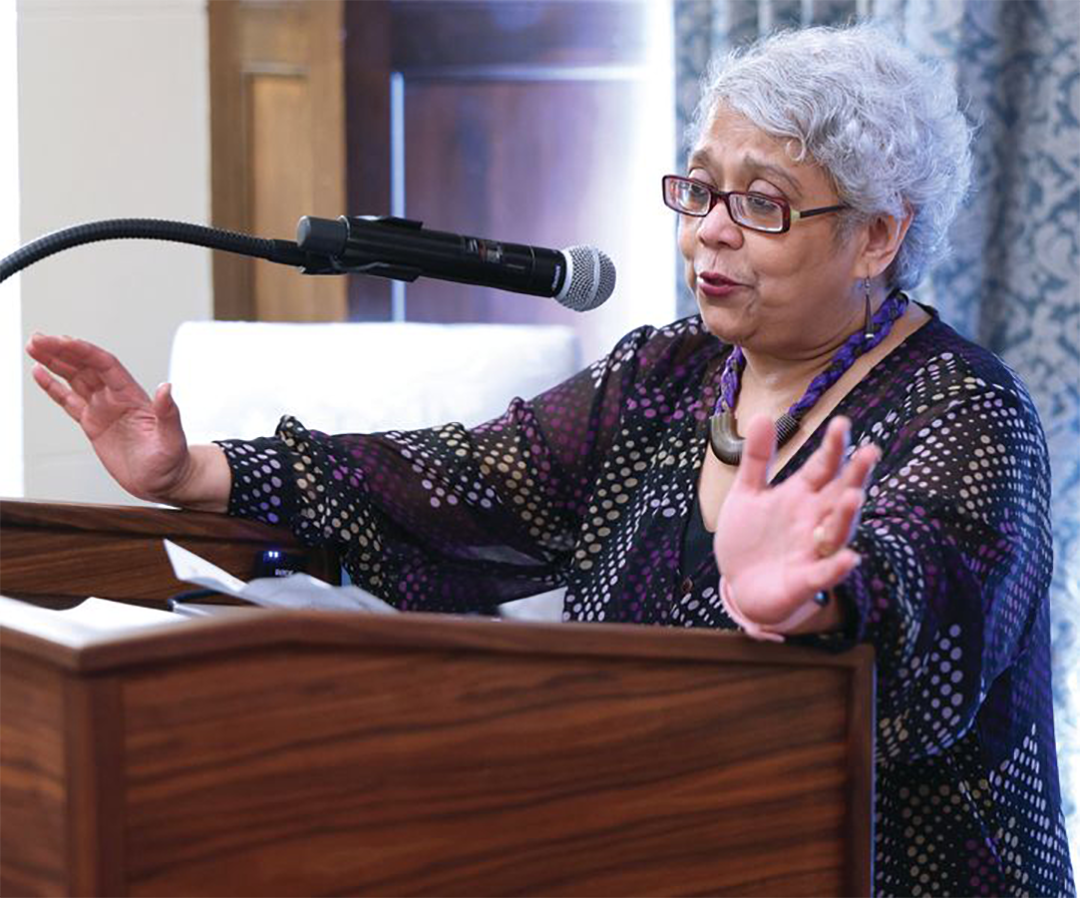
—Sangita Gopal is a professor of cinema studies and director of the Center for the Study of Women in Society.