

by Jenée Wilde, Associate Teaching Professor, Department of English
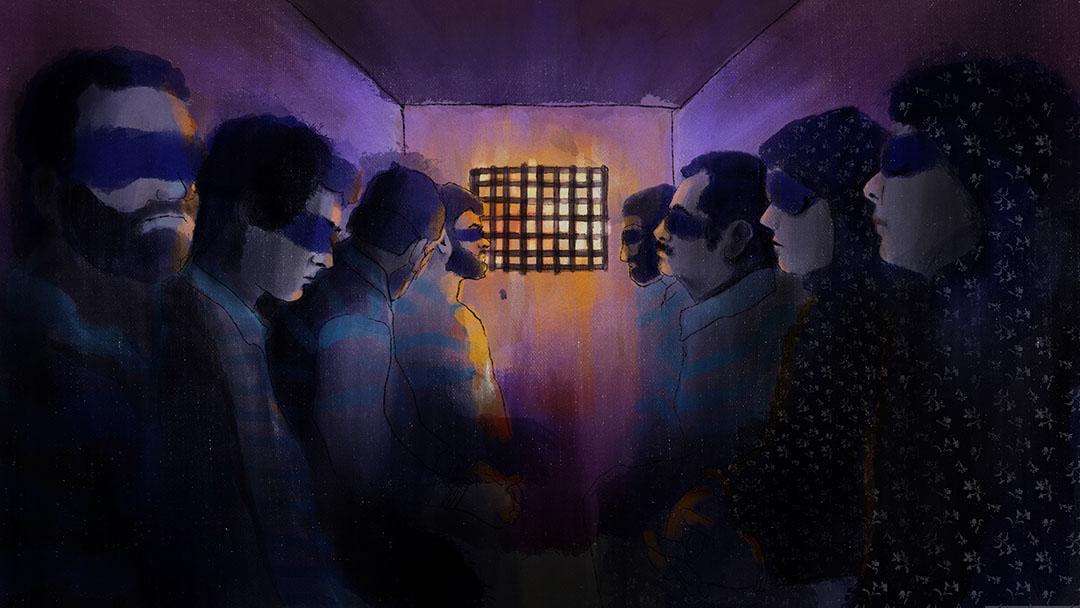
In 2025, Hoda Sobhani received a CSWS Graduate Student Research Grant to complete her award-winning animated documentary That Night. The short film takes viewers inside Iran’s notorious Evin Prison for political prisoners from the perspective of Neda, a friend who was imprisoned there for protesting the death of Mahsa Jina Amini in September 2022. Neda was among the thousands of protesters arrested as the Woman, Life, Freedom movement erupted across Tehran, resulting in one of Evin’s most congested periods in modern Iranian history. That Night delves into the harrowing experiences of inmates when a major fire broke out in the prison. Through Neda’s story, the documentary provides a detailed insight into Evin’s cells, her co-inmates’ emotional turmoil, and their desperate attempt to find a glimmer of hope amidst the chaos.
Since its premier at DOC NYC in December 2025, That Night has screened at major international festivals, including Hot Docs, Santa Barbara International Film Festival, Annecy International Animation Film Festival, and the Dallas International Film Festival, where it received the Grand Jury Prize for Best Animated Short. Sobhani holds an MFA in Social Documentation from the University of California, Santa Cruz, an MA in Cinema Studies from Sooreh University in Tehran, and a BA in Theatre Directing from the University of Tehran. She graduated in June with a master’s degree in conflict and dispute resolution from the UO School of Law.
Jenée Wilde: Why did you come to the University of Oregon?
Hoda Sobhani: I studied film in Iran, but it was mostly fiction film. Then when I moved to the US seven and a half years ago, I started the social documentation program at the University of California, Santa Cruz. We were doing all kinds of documentary producing, editing, and directing. After I finished that program, I entered the conflict and dispute resolution program here because I wanted to pursue more specifically conflicts in prison and to bring a focus on telling the stories of those in prison. So my focus in the conflict and dispute resolution program was around conflicts in prison and telling the stories in documentaries.
JW: Tell us about your film. What inspired you to make it?
HS: My film is called That Night and it’s a short animation documentary. It’s 11 minutes and we use rotoscope and 2D animation to go through Neda’s journey. Neda is my protagonist who was inside of Evin Prison in Iran back in 2022 during the Woman, Life, Freedom movement. One night a fire broke out inside Evin Prison. This is the story of what happened to Neda and her cellmates that night and how they survived. What were their strategies, you know, and what were the emotions around what they were experiencing?
Neda has been my friend for more than 20 years now, so this personal connection I have to the subject was the main inspiration for me, because that night obviously I was very worried about her. There were all of these videos and news around a fire inside of Evin Prison, but we didn’t have any connection, or even those who were in Iran, they didn’t have any connection to inside of the prison, so for six or seven hours we were in complete uncertainty of if they are alive or not. A few days after she got released, it was very emotional for me to hear from her and to have this connection back. And so I thought, I need to document this survival strategy.
JW: Where were you in your own higher ed career at that point? Were you already at UO or was it before you came here? How did the project emerge from what you were already planning on doing with your career?
HS: I was here in the US and in Oregon, and I was about to start my program at UO. After I moved from Iran to here back in 2018, Neda got arrested for the first time, so 2022 actually was her second imprisonment. But the first time that she got imprisoned, it was back in 2019 when she was protesting for May Day or Labor Day, and she was inside of Evin Prison for a year at that time. That was the first year of my being here in the United States and being far from home.
When she got released after her first imprisonment, we started writing letters. She wrote about what she felt being in prison for 10 or 11 months, and for me how being far from home and my best friend being in prison felt, and all those matters. We wrote those letters not to make a film, but at that point, we were writing the letters just to heal the trauma experience, both for her and for myself. But then Covid happened, and I didn’t have a film for my Master of Fine Arts back in UC Santa Cruz. I had to do a 20-minute documentary, and I turned those letters into it. But Neda was in Iran at the time, so I was not able to send that film to festival because it was not safe for her being in Iran and exposing her.
So the second time when she was inside of prison in the Woman, Life, Freedom movement, when she got released, we did this interview and she told me about that night, but I wasn’t sure if I was going to make a film or not, because she was still in Iran. But after a few months, she left Iran and went to Germany as a political refugee. We were able to talk through that this is a time that we can expand on that interview and make a film to talk more about what’s happening inside an Evin in Iran.
JW: Why did you apply for CSWS grant support and what did it allow you to do?
HS: I applied for the graduate student research grant because it was focused around, from my point of view at least, women and their experiences in different societies. And I found this was a fit for my film because it was Neda’s experience inside of an authoritarian country like Iran, where there are so many hierarchies and everything that is happening to women in Iran. And also, I had the privilege to work with Dr. Sangita Gopal as her TA in one of the cinema studies courses.
This grant really gave me the opportunity to spend more time on sound and sound design and composing an original score for my film. I used some of the grant to pay for a composer. The original score of the film is really amazing to me, and I was so happy to be able to do that. And after that, I used some of the grant for applying and submitting the film to festivals, because there is a submission fee and it was really helpful for me.
JW: It sounds like the grant really did enable you to create the film and get it out there in the way that you wanted to.
HS: Yes, yes, it really helped me to finish the film and to be able to go through sound and color correction and all of those things that need money. That helped me to finish it as I liked, thank you.
JW: What’s the reception for your film been so far?
HS: The reception for the film so far has been great. We did the premiere at DOC NYC in New York. It’s the largest documentary film festival, so it was amazing to be there. And after that we have had it in a few film festivals, good ones like Santa Barbara International Film Festival, Hot Docs in Toronto, which is also one of the biggest documentary film festivals around the world, and we had a screening in Dallas International Film Festival a month ago, and we won the Grand Jury Prize for Best Animated Short film, which was amazing.
Right now, we are in the process of getting more resources and talking to different people about starting an Academy Award campaign in the early summer. So in summer we are going to spend time on that and then hopefully be nominated for an Academy Award next year.
JW: It certainly wouldn’t be the first Iranian film represented at the Academy Awards, so good luck to you!
HS: Thank you! We are talking about selling the film, and we were hoping for a better offer but probably we will go with PBS. They want the film. The amount is not that high, but it’s still good because so many people are going to watch it.
JW: Is there any last thing you want to say that you didn’t get a chance to yet?
HS: I just want to say thank you to the Center for the Study of Women in Society and all of UO’s faculty and departments who helped me and supported me through this journey. I was a student, you know, so it was very hard for me to find resources to make an animation film. Thanks to all of the professors on campus who supported me to make this happen.
—Jenée Wilde is the research dissemination specialist for CSWS. Editor’s note: The dialogue above was edited for brevity and clarity.