Archive for the ‘Books’ Category
Pascoe Honored Again for Her Book

Peggy Pascoe
Peggy Pascoe, UO professor of history, continues to win honors for her book, What Comes Naturally: Miscegenation Law and the Making of Race in America. After winning two of the major annual prizes from the Organization of American Historians earlier this year, she
has repeated this feat. Pascoe learned in mid-October that she is the winner of two of the major annual prizes given by the American Historical Association. They are the John H. Dunning Prize, given for the best book in U.S. history (any field, any period) and the Joan Kelly Memorial Prize in Women’s History. The award ceremony will take place at the annual meeting of the AHA in January in San Diego. Pascoe is a CSWS faculty affiliate. Read more at InsideOregon.
Oregon Book Award Finalists
Authors Barbara Pope and Debra Gwartney, both of whom have been involved with CSWS over the years, were among the finalists of the 2009 Oregon Book Awards. Barbara Pope, UO professor emerita and founding director of what was then called women’s studies, was nominated in the fiction category for the mu
rder mystery Cezanne’s Quarry (Pegasus Books). She is currently at work on a second novel.
Debra Gwartney, dissemination specialist for CSWS from 2005-2006 and currently assistant professor of English at Portland State University, was nominated in the creative nonfiction category for Live Through This: A Mother’s Memoir of Runaway Daughters and Reclaimed Love (Houghton Mifflin Harcourt).
Changing Images of Japanese Workingwomen

Actress Amami Yuki (left) accepts an award for helping to popularize “Ara-fo.”
by Alisa Freedman, Assistant Professor of Japanese Literature and Film
Editor’s Note: In 2009, Professor Freedman received a CSWS Faculty Research Grant of nearly $4,000 to support her research in Japan. On October 28, she will offer a CSWS Noon Talk in the Jane Grant Room, Hendricks Hall, to discuss her research.
Thanks to the help of a CSWS grant, I spent the summer in Tokyo, conducting research for my books on changing images of workingwomen on Japanese television, Modern Girls in Motion: Gender, Mobility, and Labor in Japan, and Tokyo in Transit: Japanese Culture on the Rails and Road. In general, my interdisciplinary work explores how the city shapes culture and psychology, giving rise to gender roles that characterize Japan. My research takes two forms. The first involves analyzing stories—those told in literature, television, journalism, cinema, and other popular media—that capture Japanese women’s experiences in a creative and thought-provoking way. The second entails wandering Tokyo to observe patterns of daily life and dominant trends and pondering the reasons behind them.
Louise Bishop: Words, Stones & Herbs
| November 5, 2009 | ||
| 3:30 pm | to | 4:30 pm |
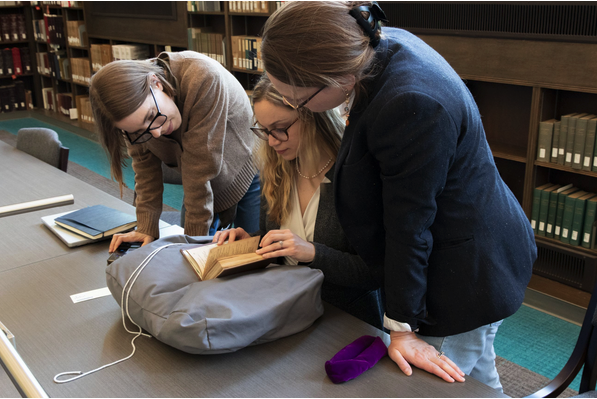
UO scholar and CSWS Executive Committee member Louise Bishop explores the healing power of words in her recent book, Words, Stones & Herbs (Syracuse University Press). In a presentation sponsored by the CSWS Healing Arts Research Interest Group, Bishop will talk about her book, which looks at the role of word and gender in healing, healing and the vernacular, and other aspects of poetry, language and metaphor in the healing arts of medieval and early modern England.
Louise Bishop is associate professor of literature and associate dean, Clark Honors College.
Place: Center for the Study of Women in Society
330 Hendricks Hall
Jane Grant Conference Room
Professor Bishop will trace the medical, theological, and popular uses of noli me tangere, “touch me not,” to situate and unmoor the phrase from its place on a remedybook’s page. She argues for a discursive relationship—highly material, eminently bodied, fully social, narratively pious, complexly gendered—between the disease name as it appears in a remedybook and the cultural resonances afforded by the phrase’s Biblical echo. A Latin phrase can take on a range of meanings in vernacular contexts. Catching the shadow of Mary Magdalene, patron saint of apothecaries, in Bodley 591’s recipe opens a space for other ways to read and contextualize Middle English remedybooks. Read in this fashion, the phrase noli me tangere enacts one of Rubin’s “creative moments” that “allows us to touch medieval bodies” (Miri Rubin) that were themselves touched by reading that heals.
Melissa Hart Reads from Her New Book
| October 15, 2009 | ||
| 5:00 pm | to | 7:00 pm |
Gringa: A Contradictory Girlhood (Seal Press, October 2009)
Campus Duck Store, 895 E. 13th Ave., Eugene

Melissa Hart
5 p.m.–5:45 p.m. Reception
5:45 p.m. Reading
6:30 p.m. Signing & Reception

Gringa bookcover
“In the 1970s and early 1980s, mothers who came out as lesbians routinely lost custody of their children to homophobic court systems and outraged fathers,” says author Melissa Hart. When she was 9 years old, this happened to her mother in Southern California, and Hart and her younger siblings weren’t allowed to live with her again until they turned 18.
Hart documented this era in her new memoir Gringa: A Contradictory Girlhood. CSWS awarded Melissa Hart a grant to work on this book in 2007. Hart teaches journalism at the University of Oregon and memoir writing for U.C. Berkeley’s online extension program. For more information about Hart’s work, visit her website at www.melissahart.com.
Book Proposal: A Faculty Workshop
Presented by the CSWS Women of Color Project: Centering Intersectionality
Ernesto Martínez
330 Hendricks Hall, Jane Grant Conference Room
This book proposal workshop features Ernesto Martínez’s book, Queer Race Narratives: On the Practice and Politics of Intelligibility. Ernesto Martínez is an assistant professor in the UO Department of Women’s and Gender Studies. His book-in-progress, Queer Race Narratives, “turns to the literature and cultural production of gays and lesbians of color in the United States in order to answer some important questions in contemporary social theory regarding the nature of knowledge acquisition and knowledge production in oppressive contexts. Specifically, this book traces discourses of intelligibility, recurring preoccupations with the labor of making sense of oneself and of making sense to others in contexts of intense ideological violence and interpersonal conflict.”