Archive for the ‘Events’ Category
CSWS Noon Talk: Scott Coltrane
| January 13, 2010 | ||
| 12:00 pm | to | 1:30 pm |
“Men and Family Work: What’s Changing, What’s Not”
Place: Gumwood Room, Erb Memorial Union
Scott Coltrane is dean of the UO College of Arts and Sciences. He has a new article coming out in the journal Sex Roles (Mexican American men and housework/childcare), an article in the Annals of the American Academy of Political and Social Sciences on social policy and men’s family work, and a chapter in a book in the Real Utopias series at University of Wisconsin that asks how gender equality could be promoted via leave and childcare programs. Read an interview with Coltrane in the 2009 CSWS Annual Review.
Finding Face: a film by Patti Duncan
| March 4, 2010 | ||
| 3:00 pm | to | 5:00 pm |
EMU Ballroom
UO Campus

Film poster for “Finding Face”
This event will feature the film “Finding Face” with filmmaker Patti Duncan.
From the Finding Face website: “‘Finding Face’ details the controversial case of Tat Marina, who was attacked with acid in Cambodia in 1999. At 16, Marina was a rising star in Phnom Penh’s karaoke music scene. She was coerced into an abusive relationship with Cambodia’s Undersecretary of State, Svay Sitha, and subsequently doused with a liter of nitric acid—allegedly by his wife—that disfigured her face. A decade later, despite the fact that there were multiple witnesses to the crime, no charges have ever been filed in the case.”

Patti Duncan
An associate professor of Women’s Studies at Oregon State University, Patti Duncan specializes in transnational feminist theories and movements, women of color in the United States, and Asian and Asian Pacific American women’s writings and experiences. She is the author of Tell This Silence: Asian American Women Writers and the Politics of Speech (University of Iowa Press, 2004).
This film event is sponsored by CSWS and the Women of Color Project.
Major Feminist Sociologist to Speak
| November 13, 2009 | ||
| 12:00 pm | to | 1:00 pm |
“Institutional Ethnography” — A Talk by Dorothy Smith
Friday, November 13 Lillis Business Complex, room 285

Dorothy Smith
Dorothy Smith is a major feminist sociologist, theorist, and methodologist. Among her many books are: The Everyday World as Problematic; Conceptual Practices of Power; and Institutional Ethnography: A sociology for people.
Dorothy Smith received the American Sociological Association’s Career of Distinguished Scholarship Award (1999) and its Jessie Bernard Award for contributions to feminist sociology (1993). She earned a Ph.D. in sociology from the University of California, Berkeley, taught at the University of British Columbia and was a professor at the Ontario Institute for Studies in Education (University of Toronto) for 25 years. At present she teaches at the University of Victoria.
Sponsored by the Center for the Study of Women in Society, the Social Sciences Feminist Network Research Interest Group at CSWS.
Cosponsored by the UO Department of Sociology and the UO Department of Women’s and Gender Studies.
Louise Bishop: Words, Stones & Herbs
| November 5, 2009 | ||
| 3:30 pm | to | 4:30 pm |
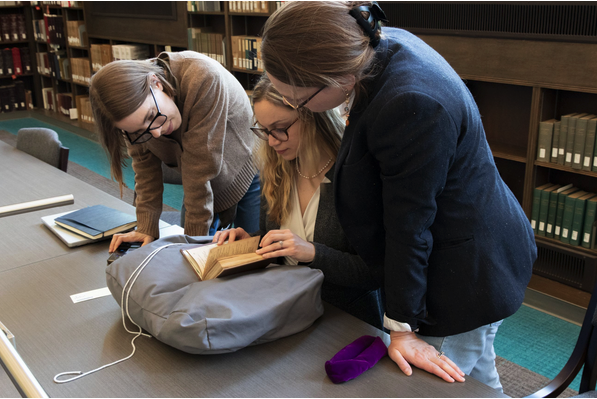
UO scholar and CSWS Executive Committee member Louise Bishop explores the healing power of words in her recent book, Words, Stones & Herbs (Syracuse University Press). In a presentation sponsored by the CSWS Healing Arts Research Interest Group, Bishop will talk about her book, which looks at the role of word and gender in healing, healing and the vernacular, and other aspects of poetry, language and metaphor in the healing arts of medieval and early modern England.
Louise Bishop is associate professor of literature and associate dean, Clark Honors College.
Place: Center for the Study of Women in Society
330 Hendricks Hall
Jane Grant Conference Room
Professor Bishop will trace the medical, theological, and popular uses of noli me tangere, “touch me not,” to situate and unmoor the phrase from its place on a remedybook’s page. She argues for a discursive relationship—highly material, eminently bodied, fully social, narratively pious, complexly gendered—between the disease name as it appears in a remedybook and the cultural resonances afforded by the phrase’s Biblical echo. A Latin phrase can take on a range of meanings in vernacular contexts. Catching the shadow of Mary Magdalene, patron saint of apothecaries, in Bodley 591’s recipe opens a space for other ways to read and contextualize Middle English remedybooks. Read in this fashion, the phrase noli me tangere enacts one of Rubin’s “creative moments” that “allows us to touch medieval bodies” (Miri Rubin) that were themselves touched by reading that heals.
Melissa Hart Reads from Her New Book
| October 15, 2009 | ||
| 5:00 pm | to | 7:00 pm |
Gringa: A Contradictory Girlhood (Seal Press, October 2009)
Campus Duck Store, 895 E. 13th Ave., Eugene

Melissa Hart
5 p.m.–5:45 p.m. Reception
5:45 p.m. Reading
6:30 p.m. Signing & Reception

Gringa bookcover
“In the 1970s and early 1980s, mothers who came out as lesbians routinely lost custody of their children to homophobic court systems and outraged fathers,” says author Melissa Hart. When she was 9 years old, this happened to her mother in Southern California, and Hart and her younger siblings weren’t allowed to live with her again until they turned 18.
Hart documented this era in her new memoir Gringa: A Contradictory Girlhood. CSWS awarded Melissa Hart a grant to work on this book in 2007. Hart teaches journalism at the University of Oregon and memoir writing for U.C. Berkeley’s online extension program. For more information about Hart’s work, visit her website at www.melissahart.com.
Book Proposal: A Faculty Workshop
Presented by the CSWS Women of Color Project: Centering Intersectionality
Ernesto Martínez
330 Hendricks Hall, Jane Grant Conference Room
This book proposal workshop features Ernesto Martínez’s book, Queer Race Narratives: On the Practice and Politics of Intelligibility. Ernesto Martínez is an assistant professor in the UO Department of Women’s and Gender Studies. His book-in-progress, Queer Race Narratives, “turns to the literature and cultural production of gays and lesbians of color in the United States in order to answer some important questions in contemporary social theory regarding the nature of knowledge acquisition and knowledge production in oppressive contexts. Specifically, this book traces discourses of intelligibility, recurring preoccupations with the labor of making sense of oneself and of making sense to others in contexts of intense ideological violence and interpersonal conflict.”