Archive for the ‘Lectures’ Category
Louise Bishop: Words, Stones & Herbs
| November 5, 2009 | ||
| 3:30 pm | to | 4:30 pm |
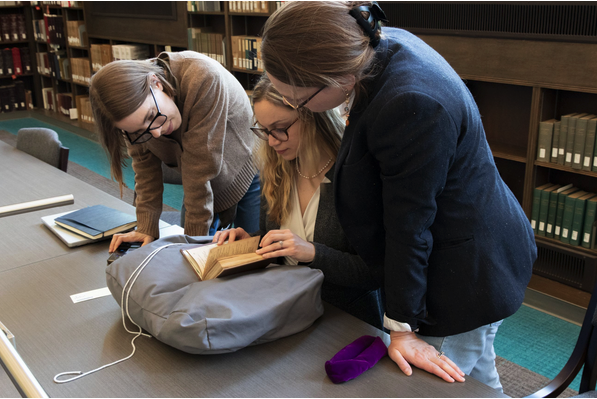
UO scholar and CSWS Executive Committee member Louise Bishop explores the healing power of words in her recent book, Words, Stones & Herbs (Syracuse University Press). In a presentation sponsored by the CSWS Healing Arts Research Interest Group, Bishop will talk about her book, which looks at the role of word and gender in healing, healing and the vernacular, and other aspects of poetry, language and metaphor in the healing arts of medieval and early modern England.
Louise Bishop is associate professor of literature and associate dean, Clark Honors College.
Place: Center for the Study of Women in Society
330 Hendricks Hall
Jane Grant Conference Room
Professor Bishop will trace the medical, theological, and popular uses of noli me tangere, “touch me not,” to situate and unmoor the phrase from its place on a remedybook’s page. She argues for a discursive relationship—highly material, eminently bodied, fully social, narratively pious, complexly gendered—between the disease name as it appears in a remedybook and the cultural resonances afforded by the phrase’s Biblical echo. A Latin phrase can take on a range of meanings in vernacular contexts. Catching the shadow of Mary Magdalene, patron saint of apothecaries, in Bodley 591’s recipe opens a space for other ways to read and contextualize Middle English remedybooks. Read in this fashion, the phrase noli me tangere enacts one of Rubin’s “creative moments” that “allows us to touch medieval bodies” (Miri Rubin) that were themselves touched by reading that heals.
“‘Salvation in His Arms?’: Racial Reconciliation in a ‘Post’-Racial Era”—Rebecca Wanzo Lecture
| October 21, 2009 | ||
| 3:00 pm | to | 5:00 pm |
Fir Room, Erb Memorial Union.
“Salvation in his Arms?: Racial Reconciliation in a ‘Post’-Racial Era”
a lecture by Rebecca Wanzo, associate professor of Women’s Studies and English at Ohio State University.
Paper summary: Are we in a “post”-race era? How do Hollywood narratives contribute to discourse about a post-racial U.S.? In a discussion of recent Hollywood melodramas that depict white men saving black women, Wanzo explores how racial reconciliation narratives in the 21st century treat therapy as the answer to structural and institutional ills.
Sponsored by the Department of Ethnic Studies, Women and Gender Studies, and Center for the Study of Women in Society.
CSWS Director Carol A. Stabile has this to say about Rebecca Wanzo’s new book:
“Tracing the invisibility of the suffering of African American women across media, The Suffering Will Not Be Televised offers an important analysis of the many ways in which African American women’s experiences have been excluded from narratives about social violence and victimization. Wanzo’s book serves as a reminder about the necessity of considering gender and race relationally for women’s studies, cultural studies, and studies of crime, media, and culture.” — Carol A. Stabile, author of White Victims, Black Villains: Gender, Race, and Crime News in U.S. Culture
A Talk with Gina Dent
| February 4, 2010 | ||
| 2:00 pm | to | 5:00 pm |

Gina Dent
Browsing Room, Knight Library
UO Campus
Gina Dent is associate professor of Feminist Studies, History of Consciousness, and Legal Studies, Director of the Institute for Advanced Feminist Research at UC Santa Cruz, and also Chair of the UC Santa Cruz Feminist Studies Department. She received her Ph.D. in English and Comparative Literature from Columbia University.
This talk is sponsored by CSWS and the Women of Color Project.
CSWS Road Scholars’ Presentation Grants for Graduate Students
The National Women’s History Project has selected the theme “Writing Women Back Into History” for 2010. In recognition of this theme, and in support of the continued work of women’s history, CSWS’s Road Scholars Program is organizing a series of talks that will be made available to Eugene public schools and other public venues for Women’s History Month (March 2010).
CSWS will make awards of $200 each for presentations by graduate students that address some aspect of this broad theme. Presentations that situate women’s history in relation to race, ethnicity, class, or ability, or in an international context, are strongly encouraged. These 20–30 minute presentations need to be accessible to a very general audience, likely to be middle or high school students.
Those graduate students who receive awards will be expected to be available to give their presentation once (and no more than twice) in public venues to be organized by CSWS.
To apply, graduate students must submit the following by 10/7/09:
- Curriculum vitae
- 500 word abstract describing the proposed presentation
- Sample bibliography
Drop application materials by our office or send them to: CSWS 340 Hendricks Hall University of Oregon Eugene OR 97403-1201
For more information, email: csws@uoregon.edu
Selected students will be asked to present their proposal to a CSWS committee before 11/1/09.
Sally Miller Gearhart Lecture

Celebrating the first lecture of an ongoing series.
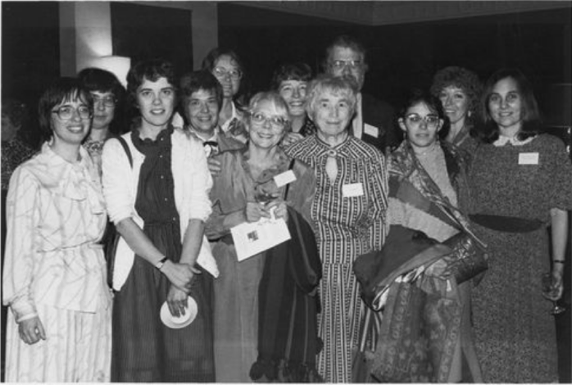
May 27, 2009—Sociologist Arlene Stein delivered the first University of Oregon Sally Miller Gearhart Lecture in Lesbian Studies. Sally Miller Gearhart founded and designed the Women’s Studies Program at San Francisco State University; she is a pioneer in the field of feminist science fiction; and a tireless fighter for progressive causes. Here she is at a dinner sponsored by Center for the Study of Women in Society to celebrate the inauguration of this lecture series, the departmentalization of Women’s and Gender Studies at the University of Oregon, and Sally’s life and work. (l-r Donella-Elizabeth Alston, Coordinator, Ethnic Studies Department; Sally Miller Gearhart; Carol Stabile, Director, CSWS)
Major Feminist Sociologist to Speak
“Institutional Ethnography” — A Talk by Dorothy Smith
Friday, November 13 Lillis Business Complex, room 285
Dorothy Smith
Dorothy Smith is a major feminist sociologist, theorist, and methodologist. Among her many books are: The Everyday World as Problematic; Conceptual Practices of Power; and Institutional Ethnography: A sociology for people.
Dorothy Smith received the American Sociological Association’s Career of Distinguished Scholarship Award (1999) and its Jessie Bernard Award for contributions to feminist sociology (1993). She earned a Ph.D. in sociology from the University of California, Berkeley, taught at the University of British Columbia and was a professor at the Ontario Institute for Studies in Education (University of Toronto) for 25 years. At present she teaches at the University of Victoria.
Sponsored by the Center for the Study of Women in Society, the Social Sciences Feminist Network Research Interest Group at CSWS.
Cosponsored by the UO Department of Sociology and the UO Department of Women’s and Gender Studies.